Why Amazon PPC Campaign Optimization Requires Real Profit Data
Every PPC tool I've used defaults to "25% ACoS is healthy." For my HardWax Oil at Rowdy Rooster Woodworks, that rule of thumb would have me pausing one of my best keywords. The rule isn't wrong because of bad math. It's wrong because it doesn't know what I sell.
The math most sellers skip
One unit of my HardWax Oil:
The short version
- Most PPC tools default to "25% ACoS is healthy", a generic benchmark averaged across thousands of accounts with completely different margins.
- One unit of HardWax Oil at Rowdy Rooster Woodworks sells for $28.95 against $4.34 referral fee, $4.76 FBA fulfilment, $4.50 COGS and $0.75 ship-to-FBA — $14.35 of cost and $14.60 of pre-ad profit.
- That makes the break-even ACoS for this product about 50%, so anything below it makes money and anything above it loses.
- The "hardwax oil" keyword ran 63 clicks, 10 orders and $88.31 of spend over 30 days for a 31.7% ACoS — hot by the generic rule, comfortably profitable by the product's real numbers.
- An optimizer running on default thresholds would pull that bid down to fix a problem the product does not have.
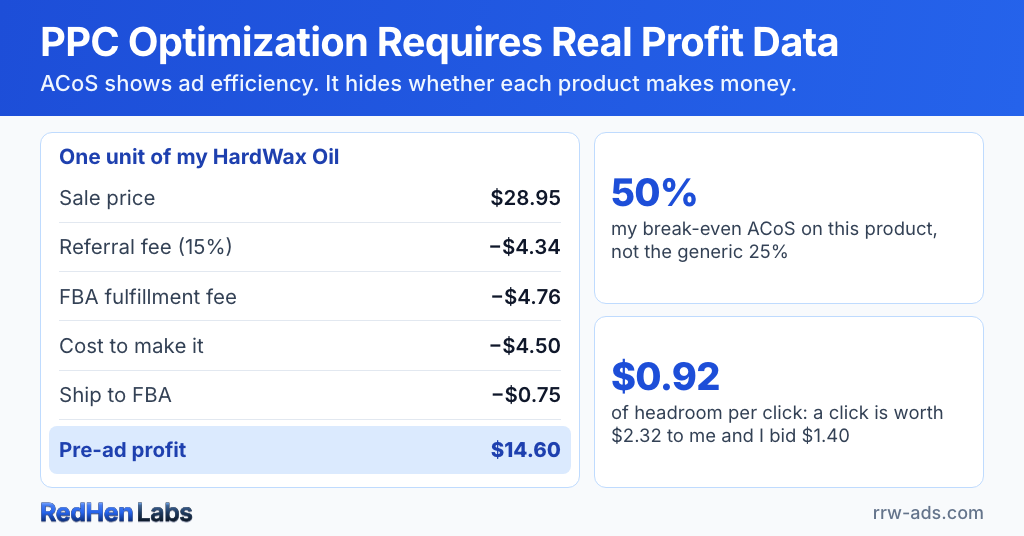
- Sale price: $28.95
- Amazon referral fee (15%): $4.34
- FBA fulfillment fee: $4.76
- COGS (the actual cost to make it): $4.50
- Ship-to-FBA cost: $0.75
- Total cost before ads: $14.35
Pre-ad profit per unit: $14.60 — about 50% of revenue.
That 50% is my break-even ACoS for this product. Anything below it makes money. Anything above it loses. The "25% ACoS is healthy" rule isn't speaking to my product — it's a generic benchmark averaged across thousands of accounts with completely different margins. Mine is more forgiving than the default. Other sellers' is tighter. Without knowing which side you're on, you're optimizing against a number that has nothing to do with whether you're profitable.
What a real break-even looks like
Take my "hardwax oil" keyword over the last 30 days: 63 clicks, 10 orders, $88.31 spent. ACoS 31.7%. Average CPC $1.40. Conversion rate around 16%.
By the generic 25% rule, this keyword is slightly hot. A "PPC optimizer" running on default thresholds would pull the bid down to "fix" it.
By my actual numbers, it's comfortably profitable with room to spare. At a 16% conversion rate, every click is worth $2.32 to me in pre-ad profit ($14.60 × 16%). I'm bidding $1.40. That's $0.92 of headroom on every click — I can push the bid up to capture more volume before I cross the break-even line. The 30-day P&L on that one keyword: 10 units at $14.60 pre-ad profit minus $88.31 spend = $57.69 net to me.
A different product with a thinner pre-ad margin would tell the exact opposite story at the same 31.7% ACoS. A keyword bid that prints money on HardWax Oil could bankrupt me on a 25%-margin item. That's why the right target isn't "lower your ACoS" — it's "know your break-even per product."
Returns don't change the math much for me. My RRW return rate runs 1-2%, so the effective margin is roughly the same. If yours runs higher because of category, sizing, or listing accuracy, bake that into your COGS line before doing this math.
How RedHen Labs handles it
The system pulls FBA fee, referral fee, and order data from Amazon's APIs automatically. You provide COGS and ship-to-FBA cost. From there you get a real per-unit P&L for each product — so when you set a target ACoS on the bid optimizer, you're working from a number you actually know rather than a 25% default you guessed. The optimizer still takes your target as input; the data just makes that input accurate.
Yes, I built this tool. I built it because every alternative I tried defaulted to "25% ACoS is good" and would have happily cut my best keywords to protect me from profit.
The TACoS vs ACoS breakdown covers why even a smarter efficiency metric still doesn't tell you whether individual products make money.
Real optimization starts with real numbers per product. Not sure where your account stands today? The free 30-second PPC audit gives you a quick grade first. See how RedHen Labs builds your P&L.
Related reading
Do it step by step in RedHen Labs
Frequently asked questions
Why does Amazon PPC optimization need real profit data?
Because a generic ACoS benchmark does not know what you sell, and will act on a keyword that is actually profitable. Most PPC tools default to "25% ACoS is healthy", which is an average across thousands of accounts with completely different margins. For HardWax Oil at Rowdy Rooster Woodworks the real break-even is about 50%, so a tool running the default would pull the bid down on one of the account's best keywords. Without knowing which side of the benchmark your margin sits on, the number being optimized has nothing to do with whether you are profitable.
Is a 31.7% ACoS keyword profitable?
It depends entirely on the product's break-even ACoS, and for HardWax Oil at Rowdy Rooster Woodworks it is comfortably profitable. That keyword ran 63 clicks, 10 orders and $88.31 of spend over 30 days at a $1.40 average CPC and roughly 16% conversion. Against the generic 25% rule it reads as slightly hot and an optimizer would cut the bid. Against the product's real break-even of about 50%, it has room to spare.
Ready to automate the right way?
RedHen Labs combines rules with AI — and keeps you in control.