Did You Over-Optimize Your Amazon Bids? Why You Can’t Tune Your Way to Certainty
I used to think I was optimizing my bids. Looking back, I was mostly reacting to noise.
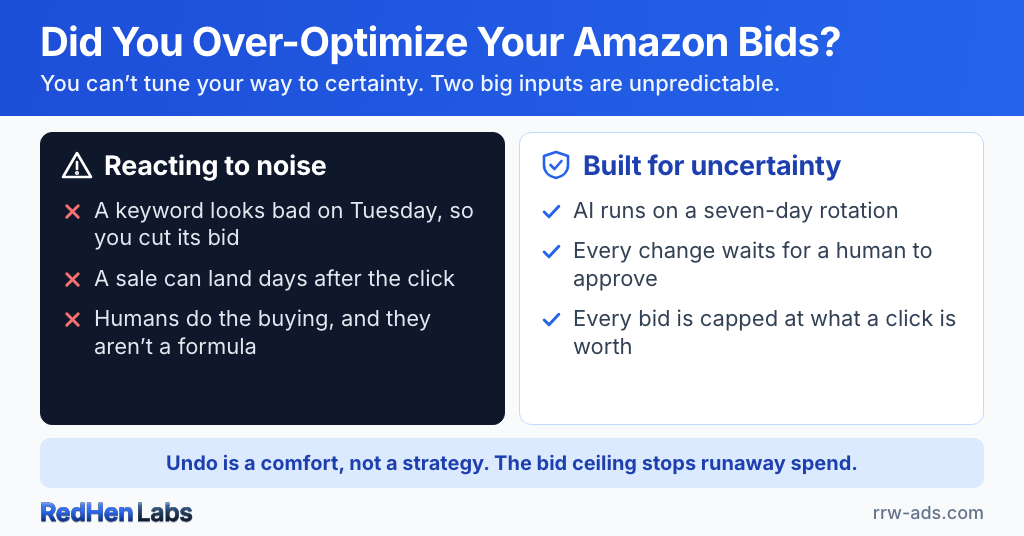
When I started on my own Amazon account, I couldn’t really read the numbers yet. A keyword looked bad on Tuesday, so I cut its bid. It looked good Thursday, so I raised it. I was sure I was tightening the account. What I was actually doing was watching bids run away and blow up my spend — over and over. That experience is the entire reason the tool I eventually built has guardrails: some you set yourself, and some that are just always on.
If you’ve been changing your bids a lot lately and your sales went the wrong way, you probably didn’t get unlucky. You probably over-optimized. And the reason it backfires isn’t the one most people think.
The thing nobody tells you: it isn’t a machine
Here’s the uncomfortable truth underneath all of Amazon PPC: you can’t tune your way to certainty, because two of the biggest inputs are fundamentally unpredictable.
The first is Amazon’s attribution. The numbers you’re staring at right now are incomplete — a sale can land days after the click, and exactly how Amazon ties it back to your ad is a game you don’t fully see.
The second is people. Humans do the buying, and humans aren’t a formula. If Amazon PPC were “do this, get that,” it would be easy and we’d all be rich. It isn’t. What you’re really doing is placing educated bets — on past performance, or guessed-at future performance — and hedging them with data over time. That’s the whole job. Not solving an equation. Placing and hedging bets.
Seen that way, over-optimization has a clean definition: treating a probabilistic system like a deterministic one — reacting to every wiggle as if it’s a signal, when most of it is noise you were never going to remove.
Why reacting daily makes it worse
Say a keyword sells nothing on Monday. On a one-day view, that looks dead, so you cut the bid. But Monday might have been noise — a slow day, a delayed conversion still settling, a few buyers who didn’t bite. You starve a keyword that was fine. Sales drop, which “confirms” your fear, so you cut again. Now you’ve talked yourself into killing something that was working, on data that was never strong enough to support the decision.
That last part is the real test, and it beats any cadence rule. Right and wrong here is fluid — the auction moves, buyers move, the bid that was right yesterday isn’t today. So the question is never “have I waited the right number of days.” It’s: can the data actually back this change? A single noisy day can’t. A clear seven-day trend can. If the data can’t support the move, the move is a guess wearing a lab coat.
A system built for uncertainty, not against it
I don’t trust myself to eyeball this in the moment — that’s how I blew up my account in the first place. So instead of reacting, I built the discipline into the system, and every piece of it is a direct answer to the thesis.
It works on a rhythm, not a reflex. The AI runs on a seven-day rotation — enough time for a small change to actually mean something — and weighs the whole bid-change picture for context instead of yanking one keyword on one bad day. Prefer to drive manually? You set your own rules and your own window from your own experience. Either way, the window exists, because acting inside the noise is the mistake. It’s the same reason I run both a rules engine and the AI: some calls are mechanical, some need judgment.
And by default nothing fires on its own. Every change waits for a human to approve it, because you’re signing off on a bet, not rubber-stamping a calculation. Once you’ve watched it be right, you can let small bid moves go out by themselves, inside limits you set.
The ceiling: an AI with a leash
Here’s where what I built goes the opposite direction from most PPC tools. The usual pitch is “our AI maximizes your bids.” Mine has a leash.
Every bid is capped at a level tied to what a click is actually worth to me — roughly my conversion rate against what I can afford to pay for an order, which is really just knowing your real per-product economics. The AI is free to compete hard right up to that line — and not a cent past it.
That distinction matters more than it sounds. Sometimes the market’s bids climb to levels that make no economic sense for a product — someone with deeper pockets or a different strategy decides to overpay, and the auction price detaches from what the click is actually worth. A tool whose only instinct is “maximize” follows them up and calls it staying competitive. Mine doesn’t. The AI tries, hits the ceiling, and stops — so a bidding war I can’t win on the math gets capped instead of chased. I lose that auction and keep my margin, which is the right trade almost every time.
A leash sounds less impressive than “maximize” in a sales pitch. In a real account it’s the difference between a system that works for you and one that quietly spends you into the ground in the name of winning. That ceiling is the thing that actually saved my account — not the undo button. Some of those guardrails you set yourself; some are baked in, because I learned the hard way that they have to be.
Yes, there’s an undo — but it’s a comfort, not a strategy
Every change is logged with its before-and-after value, and you can revert any bid in one click. It’s genuinely reassuring to have. But I’ll be honest about what it is: a comfort feature. If you’re leaning on undo, the damage already happened. What keeps bids from running away isn’t being able to walk them back — it’s the ceiling that never let them run.
The takeaway
You’re making educated bets, with incomplete data, against a moving target and unpredictable buyers. That’s not a flaw in your process — it’s the game. The goal was never the perfect bid; there isn’t one. The goal is a system built for uncertainty: changes the data can actually support, a cadence that outlasts the noise, a human approving the judgment calls, and a ceiling you can’t blow past in a panic or a bidding war you were never going to win. Stop trying to win every auction. Win the ones that make you money. See your real numbers — free for 14 days.
Frequently asked questions
Can you over-optimize Amazon PPC bids?
Yes. Over-optimizing means reacting to short-term noise as if it were signal — cutting or raising a bid on a day or two of incomplete data. Because Amazon attributes conversions days after the click and buyers are unpredictable, frequent reactive changes often starve keywords that were actually fine, and sales drop. The fix is to change bids only when the data can support the decision — a seven-day trend, not one day.
Why did my sales drop after I changed my bids?
Often because the changes were based on too little data. A keyword can look dead on a single slow day while a delayed conversion is still settling in Amazon's attribution; cut the bid and you starve it, sales fall, and you cut again. Reverting the recent changes and letting the campaign restabilize over a couple of weeks usually recovers it.
How often should you change Amazon PPC bids?
It's less about a fixed cadence than whether the data backs the change. A sane default is a seven-day window — enough for a small change to mean something against Amazon's attribution lag. Many changes across a large account are fine; repeatedly yanking the same keyword on daily noise is the mistake.
How do you stop Amazon bids from running away?
Set a maximum-bid ceiling tied to your economics — roughly your conversion rate times what you can afford to pay per order — so automation can compete up to that line and no further. A ceiling prevents runaway spend far more reliably than an undo button, because it stops the bid before it ever climbs too high.
Related reading
Do it step by step in RedHen Labs
Ready to automate the right way?
RedHen Labs combines rules with AI — and keeps you in control.