Rule-Based vs AI Amazon PPC: Why I Use Both on My Own Amazon Account
I run my own brand, Rowdy Rooster Woodworks, and its ads run on both a rule engine and an AI. I also build the tool, so the bias is real, and so is the account. I wrote the first version of this article in June 2025. How I split the work has changed since, mostly because the AI got a lot better.
The short version
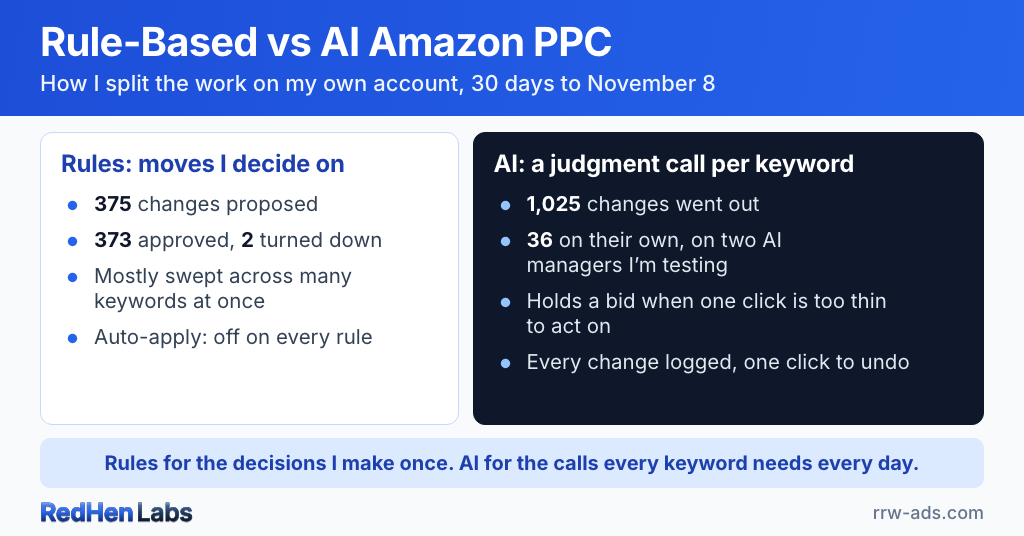
- My account runs on both: in the 30 days to November 8, 1,025 changes came from the AI and 375 from rules.
- Rules are moves I decide on, mostly swept across many keywords at once. I approved 373 of 375, and auto-apply is off on every rule.
- The AI decides keyword by keyword and reads more than one number, like holding a bid when one click is too thin to act on, or waiting for a placement change first.
- On two AI managers, my cutting board gel and my hardwax oil, auto-apply is on as an internal test: 36 changes went out on their own, inside fixed limits.
- Every change from either side is logged with the numbers it acted on and can be undone in one click.
What a rule is: a move I decide on
A rule does exactly what you tell it, every time. If a keyword had few impressions this week, raise its bid 30%. If a search term has 20 clicks and no order, add it as a negative. There’s no judgment in it, and that’s the point: the judgment happened when I wrote the rule.
These days I mostly use rules as sweeps: a move I’ve decided on, applied across many keywords at once. In the 30 days to November 8 my rules proposed 375 changes. The biggest were a 30% raise on keywords that weren’t getting impressions, across all my campaigns, and a 19% cut on a set of my gel’s keywords. I approved 373 and turned down 2. Every one waited for me.
What the AI does: a judgment call per keyword
The AI makes the same kinds of moves (bid changes, harvests, negatives), but it decides keyword by keyword and reads more than one number. Some of its calls from the last few days, on my own brand terms:
- “rowdy rooster hardwax oil”: one order at 2.26% ACoS, from a single click. It held the bid, because one click is too thin to act on.
- “rowdy rooster cutting board wax”: it held the bid because the placement step was raising Top of Search first, and a placement raise multiplies every bid in the campaign.
- “rowdy rooster mineral oil”: 2 orders from 2 clicks. It moved the search into its own exact-match keyword.
A simple ACoS rule would have raised the first one. The AI saw that one click isn’t evidence yet.
Where the work goes now
In the same 30 days, 1,025 changes from the AI went out on my account, against 375 from rules. That’s the shift since the first version of this article. Our AI process has gotten really good, so it carries the day-to-day keyword work, and I keep rules for the moves I decide on myself.
Who presses the button
The first version of this article said neither side acts on its own. That’s no longer true, so here it is exactly:
- Rules: every change waits for my approval. Auto-apply is off on all of them.
- AI: most changes wait too. On two AI managers, my cutting board gel and my hardwax oil, I’ve switched on auto-apply as an internal test. There, the AI can move a bid up to 15% or down 25% on its own; pauses, negatives, new keywords and placement changes still wait. 36 changes went out that way in those 30 days.
- Everything: logged, with the numbers it acted on, and one click to undo.
The full list of what may go out on its own is in the black-box article.
Why I still use both
For now, that’s the split. Rules are how I make a decision once and apply it everywhere, and the AI is how every keyword gets a judgment call every day without me making each one. Which side carries more of the work has already changed once, and it may change again.
Growth ($69 a month) includes the AI recommendations, with auto-apply when you want it. Professional ($129) adds the rule engine. Pricing is flat, never a percentage of your ad spend.
Frequently asked questions
Should you use rule-based automation or AI for Amazon PPC?
Both, for different jobs. On my account rules carry the moves I decide on myself, usually applied across many keywords at once, and the AI makes the keyword-by-keyword judgment calls. In the 30 days to November 8, 1,025 changes came from the AI and 375 from rules.
What can a rule-based PPC automation not do?
Weigh context. A rule applies the same threshold to every keyword that crosses it. The AI reads more than one number: on my account it held the bid on a keyword with one order from a single click, because one click is too thin to act on, and held another while the placement step raised Top of Search first.
Does RedHen Labs' AI change bids without approval?
Only where you switch auto-apply on, one AI manager at a time, and only small bid moves: up to 15% up or 25% down. Pauses, negatives, new keywords and placement changes always wait. I run it on two AI managers as an internal test; everything else on my account, rules included, waits for my approval.
Do RedHen Labs rules apply changes automatically?
Rules run on their schedule and propose changes; whether those changes apply on their own is a setting on each rule. On my account auto-apply is off on every rule, so all 375 rule changes in the last 30 days waited for me, and I approved 373.
Related reading
Do it step by step in RedHen Labs
Ready to automate the right way?
RedHen Labs combines rules with AI — and keeps you in control.