Ready to automate the right way?
RedHen Labs combines rules with AI — and keeps you in control.
I Ran My Amazon Search Term Reports Through ChatGPT. It Told Me to Do Foolish Things.
Everyone’s first instinct now is to throw a hard problem at an AI chatbot and let it sort things out. Amazon PPC search-term reports look like the perfect candidate — messy tables of data, an obvious “tell me what to do” question. So I tried it on my own account: exported the report, pasted it in, asked what to optimize. Let me save you the time. On its own, it doesn’t work, and it’ll cost you money if you trust it.
I sell PPC software, so read this with that bias in mind. But this isn’t a “buy my thing” story — it’s a “here’s specifically why the obvious shortcut fails” story, and the reasons hold whether you use a tool or do it by hand.
What went wrong
A few things, every time.
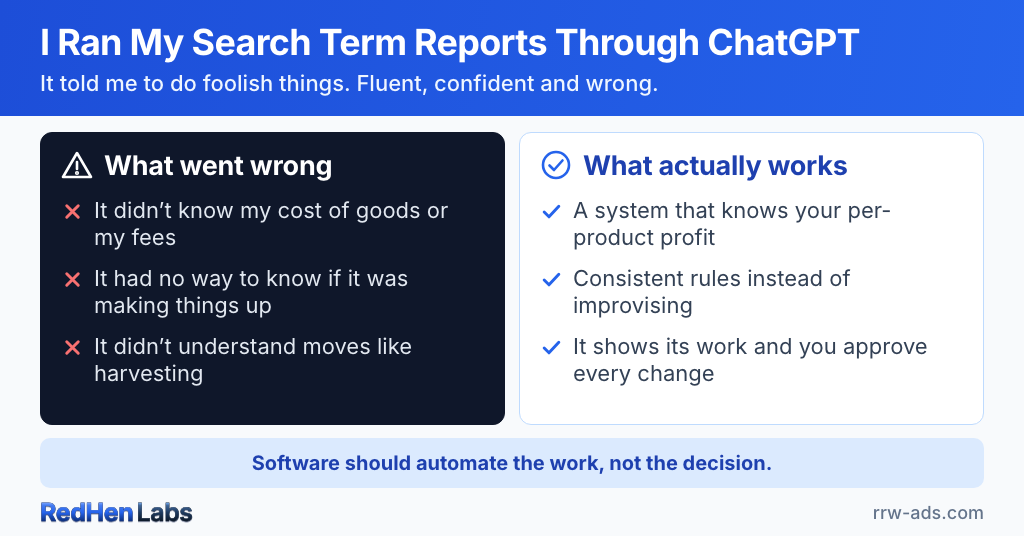
It didn’t know my profit. The chatbot sees spend, clicks, sales, ACoS. It does not know my cost of goods or my fees, so it can’t tell a keyword that’s “high ACoS but still profitable” from one that’s genuinely losing money. It confidently told me to cut terms that were making me money and scale terms that weren’t — because it was optimizing a number (ACoS) that isn’t profit.
It had no way to know whether it was making things up. Asked which terms to negate, it produced tidy-sounding recommendations that didn’t match the data — terms with two clicks and no spend flagged as “wasteful,” real money-drainers missed entirely. That’s the thing about hallucination: it isn’t random. It’s the model generating something plausible to fill a gap where it’s missing the information it would need to be right. On a big report, with no profit context, that gap is enormous.
It didn’t understand the moves. Good search-term work isn’t just “cut the bad ones.” It’s harvesting a converting term into its own exact-match keyword and blocking it in the original campaign so the two don’t bid against each other. The chatbot would suggest the harvest and forget the negation half — the exact mistake that makes your own campaigns compete with themselves.
The pattern underneath
Raw AI is genuinely useful, but on this task it needs hand-holding to be safe: the profit context it doesn’t have, guardrails so it can’t recommend something reckless, and the domain rules about how Amazon campaigns actually interact. Without those, you get fluent, confident, and wrong. By the time you’ve checked its work against your real numbers and fixed what it botched, you’ve spent longer than if you’d just done it yourself.
What actually works
The search-term report is a job for software — just not a chatbot you paste a spreadsheet into. It’s a job for a system that already knows your per-product profit, applies consistent rules instead of improvising, handles harvest-and-negate as one move, and shows its work so you approve every change. That’s the difference between “AI that maximizes a number” and AI with a leash on it.
The principle I keep coming back to: software should automate the work, not the decision. A system that knows your profit, applies rules you can see, and waits for your approval is doing work. A chatbot improvising bid changes from a number that isn’t profit is making decisions — badly.
That’s what we built into the Growth plan — and it’s why I lead with the boring version of this advice: get your reviews and profit straight first, then bring real structure to the search-term work. Pasting it into a chatbot feels like the shortcut. It’s the long way around.
Frequently asked questions
Can ChatGPT optimize my Amazon PPC?
Not reliably on its own. A general chatbot doesn't know your cost of goods or fees, so it can't tell a high-ACoS-but-profitable keyword from one that's actually losing money. Pasted a raw search-term report, it confidently recommends cutting profitable terms and scaling unprofitable ones, because it's optimizing ACoS — which isn't profit.
Why does AI give bad Amazon advertising advice?
Because it's missing the context that makes the advice correct: your profit, guardrails on what it's allowed to recommend, and the domain rules for how Amazon campaigns interact. A model fills those gaps with something plausible rather than right — that's what hallucination is — so you get fluent, confident, wrong.
What's the right way to use the search term report?
Run it through a system that already knows your per-product profit, applies consistent rules instead of improvising, handles harvest-and-negate as a single move, and shows its work so you approve every change. The principle is to automate the work, not the decision.
Related reading
Do it step by step in RedHen Labs