Ready to automate the right way?
RedHen Labs combines rules with AI — and keeps you in control.
Why Most Amazon PPC Advice Starts in the Wrong Place
Read enough Amazon PPC content and you’ll notice every site teaches the same order. Keywords first. Then campaign structure. Then bidding. Then, lately, “let AI scale you to seven figures.” It’s the standard funnel, and it’s backwards.
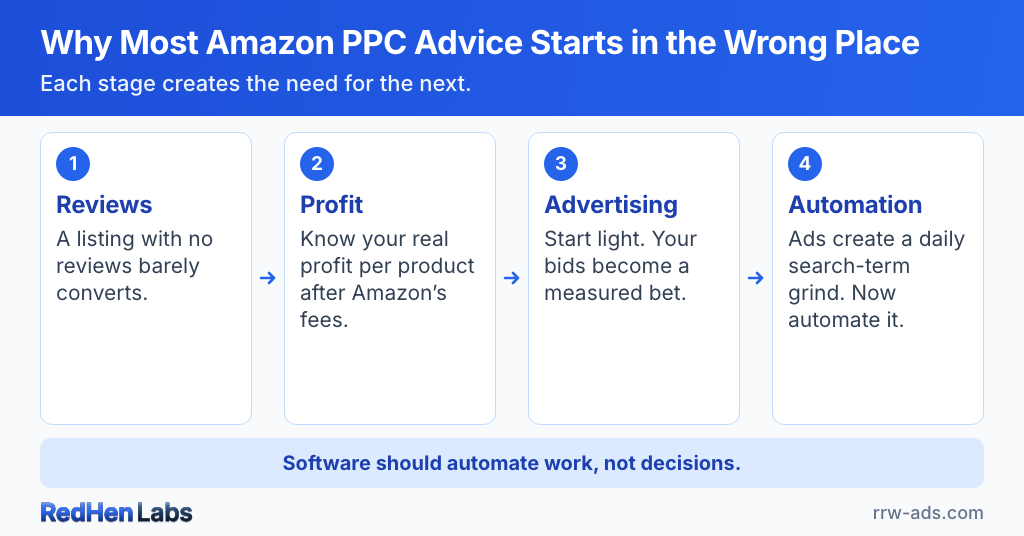
That order optimizes for what’s easiest to write about and sell — not what a real business needs first. I know, because I run one: Rowdy Rooster Woodworks, my own brand. The order that actually works looks nothing like the standard advice.
The real order
- Reviews. A listing with no reviews barely converts. Until you have an honest foundation, every dollar of traffic — paid or organic — converts worse than it should. Reviews come first because nothing else works without them.
- Profit. Before you spend on ads, know your real profit per product after Amazon’s fees. Not your sale price, not your ACoS — the actual money each sale leaves behind. That number is the budget everything else draws from.
- Advertising. With reviews and a known margin, you advertise, and you start light. Now your bids are a measured bet, not a guess, because you know the most you can pay for a sale and stay in the black.
- Automation. Advertising creates an operational workload that didn’t exist before — the daily search-term grind. That’s when automation earns its place: not to replace your judgment, but to keep up with work no human reliably does every night.
Reviews → Profit → Advertising → Automation. Each stage creates the need for the next. You can’t skip one without paying for it later.
Why the standard order gets it backwards
The keyword-first funnel teaches you to optimize bids on a product that may have no reviews and a margin you’ve never calculated. You can run flawless campaigns and still lose money, because the two things that decide whether ads even make sense — conversion (reviews) and headroom (profit) — were never set up. It’s tuning the engine before checking whether there’s a road.
And the “AI will scale you” finale skips the most important question: scale what? Automation applied to an unprofitable product just loses money faster.
The philosophy underneath
There’s a thread running through all of this, and it’s the thing I actually care about: software should automate work, not decisions.
I don’t trust black boxes, autonomous bidding, “magic” AI, or gurus with a secret. I trust rules I can see, real numbers in front of me, my approval on every change, and automation that’s measured and reversible. The standard PPC funnel sells the opposite — hand it over, trust the algorithm, scale. That’s how sellers end up unable to explain why their bids changed, or whether they’re even profitable.
So the order matters because it reflects what you should actually trust, and when. Get reviews honestly. Know your real profit. Advertise deliberately. Automate the grind — but keep the decisions. If you’re earlier in that sequence than the internet keeps insisting you should be: good. That’s where real businesses start.
Frequently asked questions
What order should a new Amazon seller do things in?
Reviews, then profit, then advertising, then automation. A listing needs an honest review foundation to convert, you need to know your real profit per product before you set ad budgets, advertising comes once those are in place, and automation earns its keep only after you are advertising enough to generate real work.
Do reviews or ads come first on Amazon?
Reviews. A product with no reviews barely converts, so paying to send traffic to it wastes money. Build a review foundation first — Vine for a launch, then the official Request a Review on every eligible order — and your ads convert far better when you do turn them on.
Should I automate my Amazon PPC?
Yes, once you are advertising in earnest — but automate the work, not the decisions. Repetitive search-term work (harvesting, negating, bid nudges) is ideal for rules-based automation, as long as you can see the rules, approve the changes, and reverse them. Avoid black-box autonomous bidding you cannot explain.
Related reading