Ready to automate the right way?
RedHen Labs combines rules with AI — and keeps you in control.
How to Get Your First Reviews on a New Amazon Product (Without Breaking the Rules)
A brand-new Amazon listing has the same problem every time: zero reviews. And a product with zero reviews barely converts, no matter how good it is — shoppers read an empty review section as “nobody has tried this yet.” So the first job on any launch isn’t ads or clever keywords. It’s getting an honest foundation of reviews on the page.
I’m in the middle of this right now. I just launched three products on my own brand, Rowdy Rooster Woodworks — an East Asian wood finishing oil, an exterior wood finishing oil, and a food-contact-safe tung-and-walnut oil — and here’s exactly what I’m doing to seed reviews on each.
Step one: Amazon Vine for the launch foundation
Vine is Amazon’s official early-review program. You enroll a product, hand over a set number of free units, and Vine’s vetted reviewers try it and write honest reviews. The units aren’t free to you, but for a launch it’s the cleanest foundation you can get.
Two things make it worth the cost. The obvious one: it puts real reviews on a listing that would otherwise sit at zero. The one people don’t talk about: Vine reviewers are tough. They’ll find a flaw you missed and describe it in detail. That stings — but it’s the cheapest product feedback you’ll ever get, far cheaper than discovering the flaw after you’ve spent thousands driving traffic to it. A product that can’t survive honest Vine feedback isn’t ready to advertise anyway.
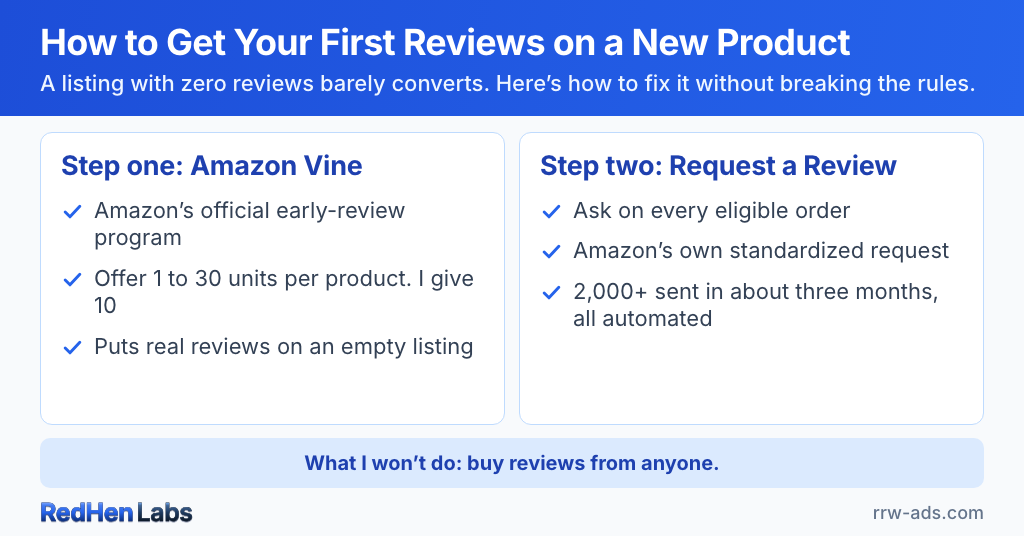
Vine lets you offer 1 to 30 units per product. I give 10. Early on you might do more to build faster; I run 10 now because I’m an established brand and that’s enough to seed a new listing without over-committing inventory. Pick a number you can afford to give away, and treat the reviews as both social proof and a free QA pass.
Step two: Request a Review on every eligible order
Vine gets you the first handful. After that, your count grows from real customers — but only if you ask. Most satisfied buyers never think to leave a review; dissatisfied ones are far more likely to take the time. Left alone, your review section skews negative.
Amazon gives you a compliant way to ask: the Request a Review button in Seller Central. It sends Amazon’s own standardized request inside the allowed window after delivery, and it’s fully within the rules because it is Amazon’s tool. The catch is doing it by hand — clicking through every order, every day, inside the eligibility window. It’s tedious enough that most sellers just stop.
On my established listings I’ve sent more than 2,000 of these across the US and Canada in about three months — all automated, none clicked by hand, with ineligible orders skipped automatically. On a fresh launch the volume is small at first, but the habit matters from day one: every early order is a review opportunity you don’t want to miss.
What I won’t do — and neither should you
There’s a whole industry that will sell you reviews: fake-review services, “influencer” deals with five stars baked in, swaps outside Vine. Don’t touch any of it. Amazon treats review manipulation as one of the most serious violations there is, and getting caught can cost you the whole account. Beyond the risk, it’s dishonest — you’d be lying to the next shopper. Earn them through a good product, Vine, and the compliant ask. Slower, but sustainable.
The honest tool note
I build software for Amazon sellers, so weigh that bias. Vine and Request a Review are both Amazon’s — I can’t and wouldn’t sell you reviews. What our $19 plan does is take the tedious part off your plate: it automates the Request-a-Review ask on every eligible order, so a new launch builds reviews on autopilot, and it shows your real profit per product while you’re at it. That’s all at that tier — reviews and profit, no ad automation, because at launch that’s what actually matters.
Get the foundation honestly. Everything else about the launch gets easier once the review section isn’t empty.
Frequently asked questions
How many Vine units should I give on a new product?
Vine lets you offer 1 to 30 units per product. There's no single right number — give what you can afford to part with. On my own established brand I enroll 10 units per product, which is enough to seed a new listing without over-committing inventory; an earlier-stage seller might offer more to build faster.
How soon can I request a review after a sale?
Amazon's Request a Review action is available roughly 5 to 30 days after delivery, and you can send it once per order. The practical move is to ask on every eligible order inside that window — by hand it's tedious, which is why most sellers automate it.
Can I pay for reviews to launch faster?
No. Paid reviews, 'influencer' deals with a five-star baked in, and free-product-for-review swaps outside Vine all violate Amazon's policy and risk losing your account. Use Vine and the official Request a Review instead — slower, but it doesn't put everything you've built at risk.
Related reading