Ready to automate the right way?
RedHen Labs combines rules with AI — and keeps you in control.
What Should TACoS Be on a New Product? Mine Launch Near 20–29% and Settle Under 18%
You don’t choose your launch TACoS. You inherit it.
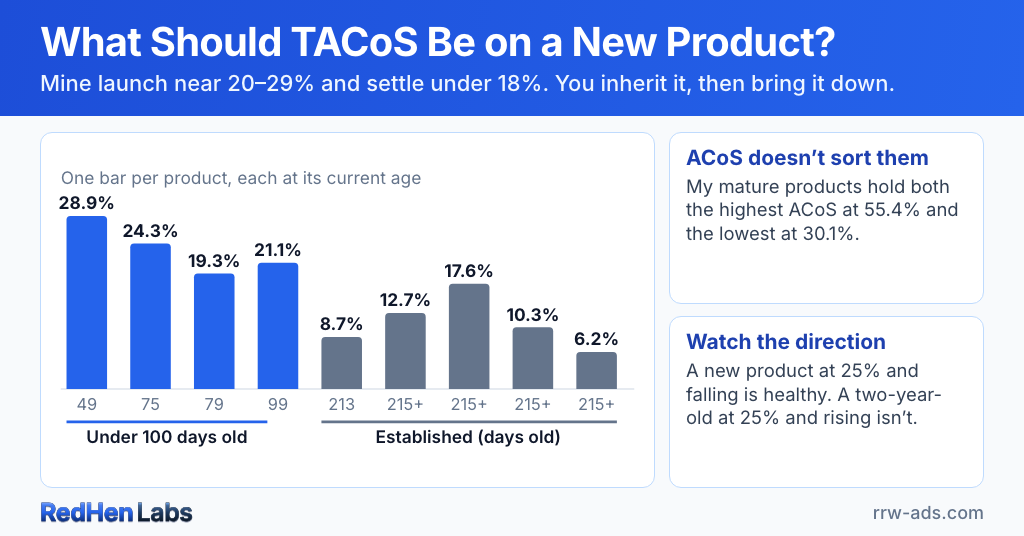
A new product has no organic sales to speak of, so advertising is buying nearly every order you get. That ratio is what TACoS measures, and at launch it is simply going to be high. The job isn’t to hit a number on day one. It’s to drive that number down as organic starts carrying some of the weight.
Here’s what that actually looks like across twelve products on my own Rowdy Rooster Woodworks account.
The numbers
| Product age | TACoS | ACoS |
|---|---|---|
| 49 days | 28.9% | 35.0% |
| 75 days | 24.3% | 45.7% |
| 79 days | 19.3% | 41.2% |
| 99 days | 21.1% | 24.8% |
| 213 days | 8.7% | 41.4% |
| 215+ days | 12.7% | 55.4% |
| 215+ days | 17.6% | 32.4% |
| 215+ days | 10.3% | 30.2% |
| 215+ days | 6.2% | 30.1% |
Four products launched in the last hundred days run TACoS between 19% and 29%. Five established ones run between 6% and 18%. Roughly two to three times the advertising support per dollar of total revenue, purely as a function of age.
The part worth stopping on
Look at the ACoS column.
It doesn’t separate them at all. My mature products hold both the highest ACoS on the list at 55.4% and the lowest at 30.1%. A new product sits at 24.8% and another at 45.7%. Handed only that column, you could not tell which products were four months old and which had been selling for the better part of a year.
TACoS sorts them almost perfectly. ACoS is noise on this question.
That’s not a knock on ACoS — it answers a different question. ACoS asks whether a campaign is efficient. TACoS asks how much of your business is being carried by advertising (the fuller comparison). Product maturity is a question about the second thing, so only the second metric can see it.
The clearest case on my list is a product with a 55.4% ACoS and a 12.7% TACoS. Read the ACoS on its own and it looks like something to cut. Read the TACoS and the business is fine — advertising is a small slice of what that product earns, because after months on the market it earns plenty without ads.
So what should yours be?
Not a number I can give you, and be suspicious of anyone who does. What I can give you is the shape:
- At launch, expect it high and don’t panic. Mine start around a quarter of revenue.
- Expect it to fall as reviews accumulate and organic rank builds. That fall is the actual evidence your launch is working — more reliable than a good ACoS week.
- Watch the direction, not the level. A new product at 25% and falling is healthy. A two-year-old product at 25% and rising is a problem, even though the number is identical.
You’re stuck with a high number in the beginning. What you control is whether it comes down.
What this data can’t tell you
Three of my twelve products aren’t in the table. Their ad spend sits inside Sponsored Brands campaigns, or they haven’t graduated enough targets to carry their own per-product spend, so I can’t attribute cleanly and I’d rather leave them out than guess.
The four oldest products show “215+ days” because that’s where my data begins, not when they launched. They’re older than that; I don’t know by how much.
And one of those mature products may be distorted by how Vine units are accounted for. I’ve left it in because the pattern doesn’t depend on it, but I’d rather say so than present it as clean.
Frequently asked questions
What should TACoS be for a brand-new product?
Expect it high and don't panic. On my own account, products launched in the last hundred days run TACoS between 19% and 29%, while established ones run between 6% and 18% — roughly two to three times the advertising support per dollar of revenue, purely as a function of age. A new product has almost no organic sales, so advertising is buying nearly every order it gets. That's what TACoS measures, and at launch it is simply going to be high.
Is a 25% TACoS good or bad?
It depends entirely on how old the product is and which direction the number is moving. A new product at 25% and falling is healthy — the fall is evidence that organic rank and reviews are starting to carry some of the weight. A two-year-old product at 25% and rising is a problem, even though the number is identical. Watch the direction, not the level.
Does ACoS tell you whether a product is still in launch mode?
No, and that surprised me. Across twelve of my products, ACoS doesn't separate new from mature at all — my established products hold both the highest ACoS on the list (55.4%) and the lowest (30.1%), while a new product sits at 24.8%. TACoS sorts them almost perfectly. ACoS asks whether a campaign is efficient; TACoS asks how much of the business advertising is carrying. Product maturity is a question about the second thing.
How do you know when a product launch is working?
TACoS falling over time is the most reliable signal I have — more reliable than a good ACoS week, which can be a single lucky period. Falling TACoS means total revenue is growing faster than ad spend, which is what happens when reviews accumulate and organic rank builds. The absolute number matters far less than the trend.
Can you set a target TACoS for a launch?
Not really — you inherit the number rather than choosing it. What you control is whether it comes down. Setting a launch TACoS target usually means either underspending on a product that needs visibility, or pretending a structural reality is a dial you can turn.
Related reading