Ready to automate the right way?
RedHen Labs combines rules with AI — and keeps you in control.
Reviews and Profit First. Then Ads — and That’s Where Your Evenings Go
I’ve made the case elsewhere that a small Amazon seller should build a review foundation and learn their real profit per product before advertising. Say you’ve done both — reviews are coming in honestly, and you know what each sale actually leaves behind. Now what? Now you advertise, and you find out why the order mattered.
Light ads are a measured bet now
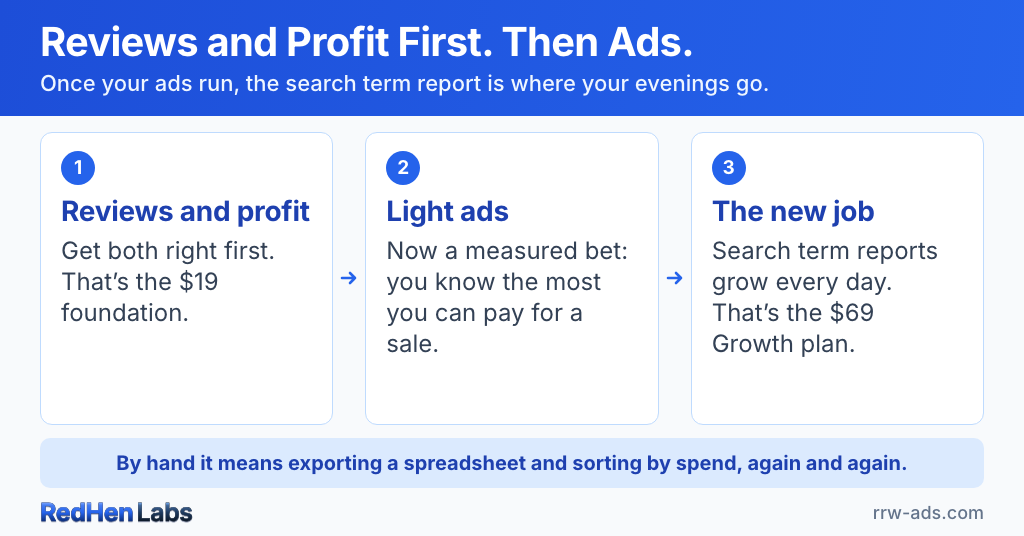
With reviews on the page and a real margin in hand, your first campaigns aren’t a gamble. You know the most you can pay for a sale and stay profitable, so you set conservative bids and a small daily budget and watch. Start light. The goal early isn’t to win every placement — it’s to learn which search terms actually convert for your product without lighting money on fire while you find out.
This is also the moment the $19 foundation stops being enough — not because the foundation changes, but because a new job appears. Running ads creates an operational workload that didn’t exist the day before. Someone has to do it.
The new job: search-term reports
The second your ads run, Amazon starts handing you data — every search term that triggered your ad, what it cost, whether it converted. Buried in that report are the terms worth bidding up, the terms worth promoting into their own keywords, and the terms quietly draining your budget that you should block. Finding them is the whole game in PPC.
It’s also genuinely hard, and relentless. The report grows every day. By hand it means exporting a spreadsheet, sorting by spend, cross-referencing conversions, deciding what to harvest into exact match, remembering to block that term in the original campaign so it doesn’t compete with itself — then doing it all again next week, forever. This is the work that eats sellers’ evenings, and the work most people quietly stop doing after a month. That’s exactly when ad spend starts leaking.
Why this is a different tier
Our $19 plan deliberately doesn’t touch any of this. At the foundation stage you don’t need bid algorithms — you need reviews and clear profit. But once you’re advertising in earnest, the search-term grind is exactly the repetitive, rules-based work software is good at and humans are bad at keeping up with: harvesting converting terms on a schedule, blocking the wasteful ones, nudging bids toward what each placement is actually worth — with you approving the changes, not a black box doing it behind your back.
That’s the Growth plan at $69, and it’s a different conversation than the foundation. The sequence still holds: Reviews → Profit → Ads. It’s just that when you finally reach “ads,” the work changes shape — and that’s where a real PPC tool earns its keep. Don’t rush to it. But don’t pretend, once you’re advertising seriously, that you can keep up with the search-term report by hand. I couldn’t, and it’s my own brand.
Frequently asked questions
When should a new Amazon seller start running ads?
Once a product has an honest foundation of reviews and you know its real profit per unit. With both in hand, you can set conservative bids against a margin you actually know and start light — instead of guessing with your own money on a product that doesn't convert yet.
What is a search term report?
It's Amazon's record of every customer search term that triggered your ads — what each cost, and whether it converted. Buried in it are terms worth bidding up, terms worth promoting into their own keywords, and terms quietly draining budget that you should block. Working it well is the core of Amazon PPC.
Do I need a PPC tool to manage Amazon ads?
Not on day one. Early on you need reviews and clear profit, not bid algorithms. But once you're advertising in earnest, the daily search-term grind — harvesting, negating, adjusting bids — becomes more than most sellers keep up with by hand, and that's where a PPC tool earns its keep.
Related reading
Do it step by step in RedHen Labs