Ready to automate the right way?
RedHen Labs combines rules with AI — and keeps you in control.
What Is a Good ACoS on Amazon? (Mine Runs 37% — and That’s Fine)
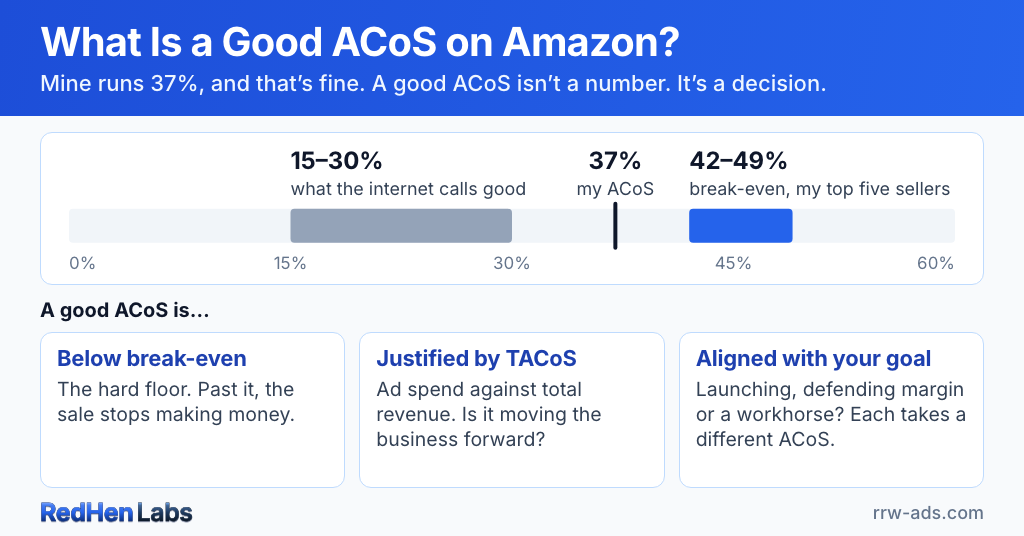
Ask the internet “what’s a good ACoS on Amazon?” and you’ll get a number — usually somewhere between 15 and 30%. Here’s the more useful answer: there isn’t one. My own account runs around 37% ACoS right now, and it’s fine. But my number isn’t the story — yours is. So here’s the thesis up front, and the rest of this is just the reasoning behind it: a good ACoS is below break-even, justified by TACoS, and aligned with your objective. My 37% is evidence for that, not the conclusion. None of what actually decides it is a benchmark.
Why “15–30% is good” is wrong
That benchmark assumes every product and every seller wants the same thing. They don’t. A good ACoS is determined by each seller and their objectives — and here’s what surprises people: one healthy account usually runs several objectives at once. Mine does. Right now my account is running three different strategies with three different ACoS tolerances at the same time — products I’m launching, where I accept a high ACoS to buy rank; proven products where I’m defending margin and keep it tight; and workhorses in between. No single number is “good” for all three. A benchmark tries to answer with one number a question that has three different answers inside my own account.
The floor: below break-even
There’s one hard line underneath all of it. Whatever your objective, a good ACoS is at minimum below that product’s break-even — the point where the sale stops making money. On my catalog that runs 27% to 49% depending on the SKU, and 42% to 49% on my five best sellers (here’s exactly how to calculate break-even ACoS per product). So my 37% sits comfortably under my best sellers’ break-even, which is precisely why “keep it under 25%” would be bad advice for me: it would have me cutting bids on profitable sales to chase a number off a blog. Break-even is the floor of the answer. It is not the target.
The real judge: TACoS
The metric that actually settles whether my 37% is okay isn’t ACoS at all — it’s TACoS. ACoS tells you how efficient one campaign is; TACoS — ad spend against your total revenue, organic and paid — tells you whether the whole ad investment is moving the business forward or just renting sales you’d have gotten anyway. My TACoS picture is what justifies the 37%, and it’s the number I actually manage to. ACoS is the speedometer; TACoS is whether you’re getting where you’re going. (More on that in TACoS vs ACoS.)
Your objective isn’t fixed
The third input is your objective for the product, and it changes. A launch is one of several times you’ll intentionally accept a higher ACoS — you’re spending to buy rank and reviews on a SKU that hasn’t earned its organic position yet. So is a seasonal push, an inventory buy you need to move, or a deliberate ranking campaign. (My account’s a little elevated right now for exactly this reason — three new products just went live.) In every one of those cases a “high” ACoS is the correct ACoS, because the objective isn’t this week’s efficiency — it’s the position you’re buying. Judge a launching product by a mature product’s target and you’ll strangle good products in the crib.
The variable the benchmarks never mention: cash flow
And there’s a factor the benchmark articles never touch, because it has nothing to do with the ad account at all: cash flow. Two sellers can have identical products and identical break-even ACoS. One has $500,000 in the bank; the other has $5,000. The first can choose to run 55% ACoS for months — buying rank and eating thin margins because they can finance the growth. The second may have to stay under 30%, not because it’s the “right” number, but because they can’t afford to float the difference while it pays off. Same product, same math, two completely different good ACoS numbers — decided by the bank balance. A benchmark that can’t survive that isn’t worth keeping.
When a low ACoS isn’t the win it looks like
One more piece of received wisdom worth breaking: “if your ACoS is low, raise your bids.” Sometimes — but not always. A low ACoS doesn’t automatically mean you’re under-spending. Sometimes it means you’ve already captured nearly all the profitable demand that exists. I sell in some small, specific niches, and pushing ACoS higher there would mean bidding on terms that aren’t relevant to the product — which don’t convert; they just burn money. A low ACoS is only “leaving money on the table” if there’s more relevant demand to buy. Confirm the demand is real before you chase the volume.
So what is a good ACoS?
Good ACoS isn’t a number. It’s a decision. If it’s below break-even, supports your TACoS objective, and matches what you’re trying to accomplish with that product today, it’s probably the right ACoS — even if someone else’s blog says otherwise. Start with the one input that isn’t a guess: our free Break-Even ACoS Calculator gives you the ceiling for any SKU in about a minute. From there it’s your call to make — not a benchmark’s. (And if your ACoS looks fine but the profit still isn’t there, the number may be lying to you.)
Frequently asked questions
What is a good ACoS on Amazon?
There is no universal number. A good ACoS is below your product's break-even (often 40–55%, not the 25% you'll read), justified by your TACoS, and aligned with your objective for that product — launch, defend, or scale. My own account runs about 37% and that's healthy given my break-even and TACoS.
Is a 30% ACoS good?
It depends entirely on the product. 30% is great on a SKU that breaks even at 50%, and a money-loser on one that breaks even at 25%. The number alone tells you nothing without that product's break-even and your objective for it.
Is a low ACoS always good?
No. A low ACoS can mean you're under-bidding — but in a small or saturated niche it often means you've already captured nearly all the relevant, profitable demand. Raising bids there just spends on irrelevant terms that don't convert.
Is ACoS or TACoS more important?
TACoS. ACoS measures one campaign's efficiency; TACoS measures whether your total ad spend is growing the whole business. ACoS is the speedometer; TACoS is whether you're getting where you're going.
Related reading
Do it step by step in RedHen Labs