Ready to automate the right way?
RedHen Labs combines rules with AI — and keeps you in control.
Break-Even ACoS Is Different for Every SKU (Mine Run 27–49%, Not 25%)
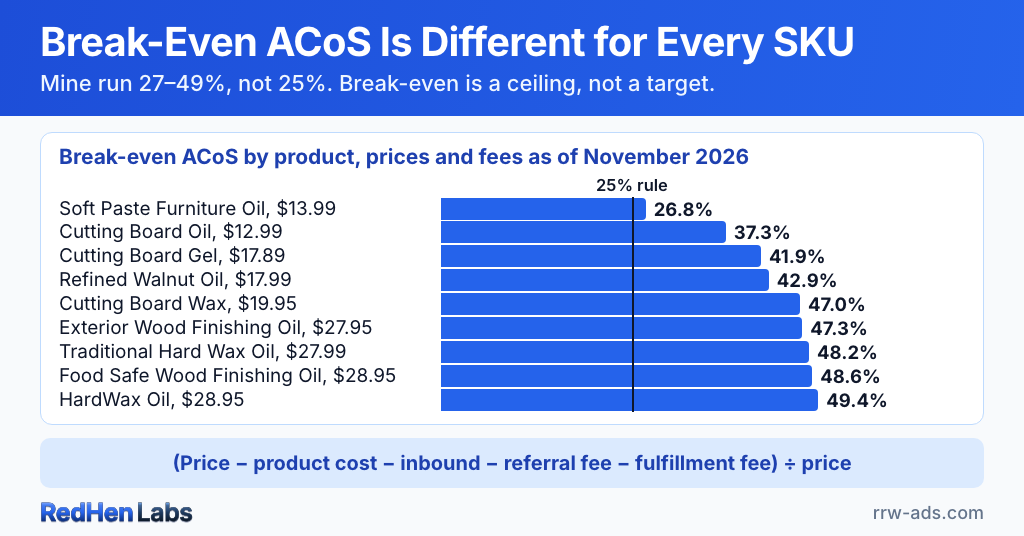
I sell wood-finishing oils on my own account, Rowdy Rooster Woodworks. Nine of my FBA products, nine different break-even ACoS numbers at November 2026 prices and fees — from 26.8% on a $13.99 paste to 49.4% on a $28.95 oil. Only that paste comes near the 25% you’ll read about online, and my five best sellers break even between 42% and 49%. If I’d managed this catalog to a single 25% target, I’d have bid myself out of my own niche on most of it. That gap is the whole point: break-even ACoS is a per-SKU number, and the “good Amazon ACoS” everyone quotes is a number for no product in particular.
Why a 25% target is a trap
In many competitive categories, a 25% target simply isn’t enough to win meaningful placement. The result isn’t efficiency — it’s low impressions, low clicks, and campaigns that quietly stop growing. The account looks disciplined; what’s actually happening is you’re bidding under the market and slowly disappearing from the pages your buyers scroll. A target ACoS you can’t win any volume at isn’t a good Amazon ACoS — it’s an expensive way to be invisible. Back to the fundamentals.
Fundamental 1: Can this product even afford ads?
Before ACoS means anything, the product has to have room in it. If your landed cost — what it takes to make the product and get it to Amazon — consumes too much of your selling price, there simply isn’t enough margin left to advertise profitably. No target fixes that; you fix it in the product, the price, or the fees. Many successful private-label products have landed costs well below 20% of retail, but the exact threshold depends on fees, pricing, and category. The test isn’t a magic percentage — it’s whether, after Amazon takes its cut, there’s enough left to pay for a click and still keep some Amazon advertising profit.
Fundamental 2: Break-even ACoS, per SKU
Break-even ACoS is the share of a sale you can hand to advertising before that sale stops making money. It’s the ceiling. Here’s the actual math — the same one behind any honest Amazon PPC calculator:
(Price − Product Cost − Inbound Shipping − Referral Fee − Fulfillment Fee)
÷ Price
Real example, my HardWax Oil: $28.95 price, minus $4.50 product cost, minus $0.75 inbound shipping, minus $4.34 referral fee (Amazon’s 15%), minus $5.06 FBA fulfillment fee, leaves $14.30 before I spend a cent on ads. Divide that by the $28.95 price and the break-even ACoS is 49.4%. Every ad dollar up to 49.4% of that sale still leaves me money.
Run it across the catalog and the point makes itself:
| Product | Price | Break-even ACoS |
|---|---|---|
| Soft Paste Furniture Oil | $13.99 | 26.8% |
| Cutting Board Oil | $12.99 | 37.3% |
| Cutting Board Gel | $17.99 | 42.2% |
| Refined Walnut Oil | $17.99 | 42.9% |
| Cutting Board Wax | $19.95 | 47.0% |
| Exterior Wood Finishing Oil | $27.95 | 47.3% |
| Traditional Hard Wax Oil | $27.99 | 48.2% |
| Food Safe Wood Finishing Oil | $28.95 | 48.6% |
| HardWax Oil | $28.95 | 49.4% |
Notice something? Nothing about these products changed except the economics. Same seller. Same advertising platform. Same account. Yet the “correct” break-even ACoS varies by more than 20 percentage points. It mostly climbs with price, because Amazon’s fulfillment fee barely moves — $4.64 on every one of my products under $20 — so it takes a bigger bite out of a $14 product than a $29 one. Product cost matters too: my $13.99 paste costs $3.00 to make and breaks even at 26.8%, while a $12.99 oil that costs $1.71 breaks even at 37.3%. Any single account-wide ACoS target is, by definition, wrong for almost every SKU it touches.
FBA or FBM — same math
If you fulfill orders yourself, there’s no Amazon fulfillment fee to plug in — you use your own pick, pack, and ship cost instead. The formula doesn’t change; just make sure the number you drop in is the real cost of getting the unit to the customer the way you ship it. Either way, the break-even is only honest if the inputs are.
Fundamental 3: Break-even is the ceiling, not the target
Knowing a SKU breaks even at 49% doesn’t tell you to run it at 49%. Break-even ACoS tells you what’s possible. Target ACoS tells you what you’re trying to accomplish. Your target is where you choose to sit under the ceiling, and it depends entirely on what you’re doing — there’s no universal answer, because there’s no universal account. I set mine to stay competitive in a tough niche while still keeping a decent profit per unit. In a knife-fight category you run closer to break-even to buy the visibility; when you’re defending a proven margin, you pull back. Different goals, different targets — off the same real break-even number.
Stop guessing what’s “good”
This is exactly why we built the Break-Even ACoS Calculator. Instead of guessing whether 25% or 30% is “good,” you can calculate what each SKU can actually afford. Once you know the ceiling, choosing a target becomes a business decision instead of a guess. If you’d rather have every product’s real Amazon FBA profit margin kept current automatically — product cost, referral, and FBA fee pulled straight from your account — that’s what the full platform does. The companion read on why a 25% ACoS can still lose money comes at the same idea from the profit side.
Frequently asked questions
Is 25% ACoS good?
There is no universal good Amazon ACoS. 25% is only good if it sits below your product's break-even ACoS — and on my own catalog, break-even runs 27–49% (42–49% on my five best sellers), so a 25% target leaves profitable spend, and placement, on the table. In a competitive category, holding to 25% usually means too few impressions to grow.
How do I calculate break-even ACoS?
Break-even ACoS = (price − product cost − inbound shipping − referral fee − fulfillment fee) ÷ price. It is the share of each sale you can spend on ads before that sale stops making money. Calculate it per SKU — a free break-even ACoS calculator does the math in about a minute.
What is a good break-even ACoS?
Break-even is not good or bad — it is a fact about the product's economics. A higher break-even (more margin left after fees) gives you more room to advertise. What matters is setting your target ACoS below each SKU's break-even, with enough cushion for the profit you want.
Does break-even ACoS differ for FBM?
The formula is identical; you swap Amazon's fulfillment fee for your own pick, pack, and ship cost. An FBM product can have a different break-even than an FBA product at the same price because the fulfillment cost is different.
Related reading
Do it step by step in RedHen Labs