Ready to automate the right way?
RedHen Labs combines rules with AI — and keeps you in control.
Know Your Real Profit on Every Product Before You Spend a Dollar on Ads
Most new Amazon sellers can tell you their sale price and their cost of goods. Far fewer can tell you what’s left after Amazon takes its cut — and that gap is where launches quietly bleed money. Before you advertise, you need one number for every product: real profit per unit, after everything Amazon charges. Here’s how I calculate it on my own catalog, and why the number is almost never what you’d guess.
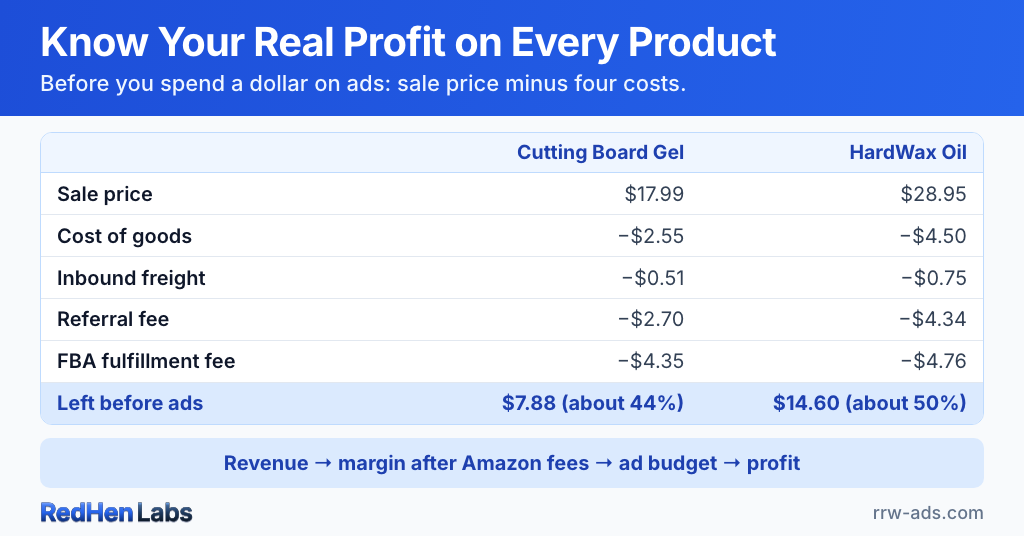
The five lines that matter
For any product, start from the sale price and subtract four things:
- Cost of goods — what the unit costs you to make or buy
- Inbound freight — cost to ship it into Amazon, per unit
- Referral fee — Amazon’s cut of the sale, usually 15%
- FBA fulfillment fee — pick, pack, ship, based on size and weight
What’s left is your real pre-ad profit — the money you actually have to work with, before advertising, returns, software, overhead, taxes, and last of all, profit.
The same math, three real products
- Cutting Board Gel — $17.99 sticker. Minus $2.55 COGS, $0.51 inbound, $2.70 referral, $4.35 FBA = $7.88 left. About 44%.
- HardWax Oil — $28.95 sticker. Minus $4.50, $0.75, $4.34, $4.76 = $14.60 left. About 50%.
- A newer wood-finishing oil at $29.95 lands in the mid-40s once you run the same lines.
Two things jump out. First, the real number is roughly half the sticker on every one — before a cent of ad spend. Second, the margins aren’t identical: the gel keeps 44%, the HardWax 50%. That difference is exactly why one blanket ad target across your whole catalog is a mistake — a percentage that’s healthy on the HardWax can be a loss on the gel.
The stage most people skip
Most sellers picture two stages: revenue, then profit. There’s a stage in between that changes everything:
Revenue → gross margin after Amazon fees → advertising budget → profit.
Your ad budget doesn’t come out of revenue. It comes out of what’s left after Amazon’s fees — and whatever you don’t spend on ads, returns, and overhead is what finally becomes profit. Skip that middle stage and you’ll budget your ads against a number that was never really yours.
Why ACoS won’t save you here
ACoS — ad spend divided by ad sales — is the number most sellers watch, and it’s blind to all four of those lines. It doesn’t know your cost of goods or your fees. You can run a “good” ACoS and still lose money on the unit, because the cost ACoS ignores is bigger than the cost it measures. Real profit per product is the floor under every ad decision. Set it first.
The part software can’t do for you
Straight talk, since I sell a tool that tracks this: no software can know your cost of goods or your inbound freight. You have to enter those — only you know them. Amazon’s fees we pull automatically; your costs we can’t. Once they’re in, the math runs itself and stays current as fees change.
That’s the core of our $19 plan: enter your costs once, see real profit per product on a screen, instead of rebuilding a spreadsheet every quarter. We also put a free FBA profit calculator out front if you’d rather run one product by hand first. Either way the point’s the same: know the real number before you advertise, not after. You can’t manage a margin you’ve never calculated — so run this for every SKU before you turn on a single campaign.
Frequently asked questions
How do I calculate real profit per product on Amazon?
Start from the sale price and subtract four things: your cost of goods, the cost to ship the unit into Amazon (inbound freight), Amazon's referral fee (usually 15%), and the FBA fulfillment fee. What's left is your real pre-ad profit — the money you actually have to cover advertising, returns, overhead, and profit.
Is ACoS the same as profit?
No. ACoS only measures ad spend against ad sales; it's blind to your cost of goods and Amazon's fees. A product can show a healthy ACoS and still lose money per unit. Profit per product is the floor under every ad decision, and it's a different number entirely.
What fees does Amazon charge per sale?
On a typical FBA sale, the two big Amazon fees are the referral fee (usually 15% of the sale price) and the FBA fulfillment fee (based on size and weight). Those are the fees Amazon can report automatically. Your own cost of goods and inbound freight aren't fees — but they come out of the same sale, and only you know them.
Related reading
Do it step by step in RedHen Labs