Amazon FBA Profit Calculator: Why My Spreadsheet Wasn’t Enough
Before RedHen Labs, I kept my profit in a spreadsheet: price, cost of goods, Amazon’s fees, a formula at the bottom. It was not pleasant. Every number in it was right on the day I typed it, and the business didn’t stay on that day.
A calculator is still the right first step. Run a product’s price and costs through one and you know what a sale is worth today. The trouble is everything that moves after.
The short version
- A profit calculator or spreadsheet is right on the day you type it; Amazon's fees and your costs keep moving after that.
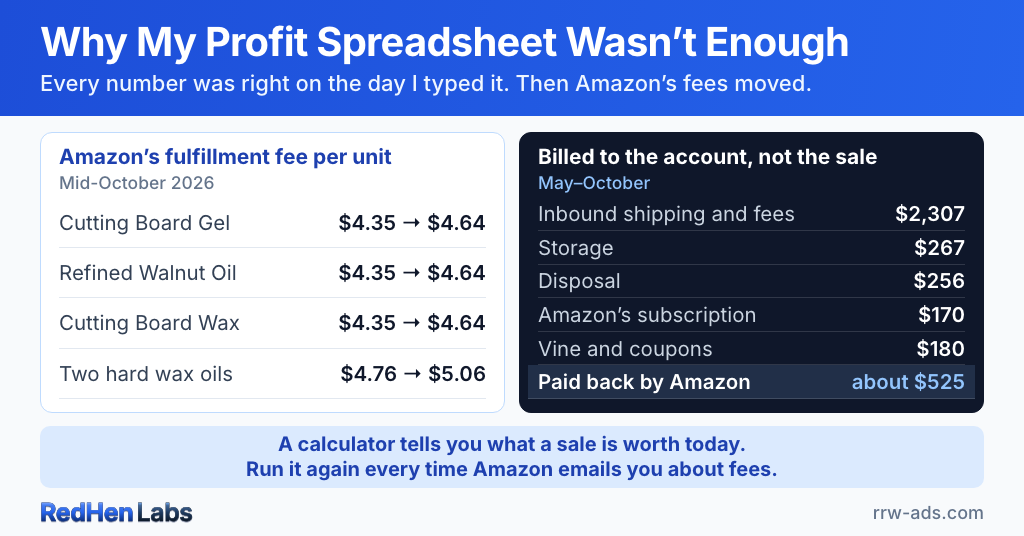
- In mid-October 2026 Amazon's fulfillment fee on each of my five best sellers rose about 30 cents a unit: from $4.35 to $4.64 on three of them, from $4.76 to $5.06 on the other two.
- Amazon bills some costs to the account rather than to a sale: from May through October I paid about $3,200 in inbound shipping and fees, storage, disposal, Amazon's subscription, Vine and coupon fees, against about $525 Amazon paid back.
- For the orders I ship myself, Amazon's label bill has run about $200 a month since August; a typed shipping number only estimates it.
- Refunds stayed under 2% of units on my three best sellers, a reminder to use your own return rate rather than a rule of thumb.
Amazon’s fees move
My cutting board gel paid Amazon about $4.35 a unit for fulfillment from May through September. In mid-October it went to $4.64. My other best sellers went up at the same time: my Refined Walnut Oil and Cutting Board Wax from $4.35 to $4.64 a unit, my two hard wax oils from $4.76 to $5.06.
I read Amazon’s email about it. I try not to think about their fees too much. That’s the honest reason a spreadsheet goes stale: nobody wants to re-type Amazon’s fee table every time it changes.
The costs Amazon bills to the account, not the sale
Some of what Amazon charges isn’t per unit at all. It arrives per shipment or once a month. From May through October, on my US account:
- $1,681 to ship inventory into Amazon
- $626 in an inbound fee Amazon’s records call a “convenience” fee
- $267 in storage
- $256 to dispose of inventory
- $170 in Amazon’s monthly subscription
- $113 in Vine fees
- $67 in coupon fees
Against that, Amazon paid back about $525 in reimbursements. A calculator can hold a per-unit guess at shipping and storage (ours has a field for each), but the real bills come per shipment or per month, and the rest has no field at all. Together: about $3,200 in six months.
Orders I ship myself
Some orders I ship myself, and I buy the labels through Amazon: about $200 a month since August, and $390 in June. A spreadsheet only knows the shipping number you gave it. As of this week, RedHen Labs counts what Amazon actually billed for those labels instead.
Returns
The usual warning is that returns eat a big share of revenue. On my three best sellers, refunds stayed under 2% of units from May through October, and I haven’t really had return issues. That’s worth knowing too: a profit model built on someone else’s return rate would have taken margin off products that don’t need it.
How I’d fill in a calculator today
- Take the fulfillment fee from your latest orders, not from a chart you saved in the spring.
- Work out inbound shipping per unit: your last few inbound shipping bills divided by the units in those shipments.
- Do the same for storage, from Amazon’s monthly storage charge.
- Use your own return rate, product by product.
- Run it again every time Amazon emails you about fees.
What I use now
RedHen Labs takes each order’s fees from what Amazon actually charged (Amazon’s own estimate until the charge posts), shows the account-level costs as their own lines, and works out profit after ads for each product. Product costs go in once; when one changes, you give the date it changed, so last month’s profit stays last month’s.
A calculator tells you what a sale is worth today. RedHen Labs keeps the answer current.
Related reading
Frequently asked questions
What does an Amazon FBA profit calculator leave out?
The costs Amazon bills to the account rather than to a sale: shipping inventory into Amazon, inbound and storage fees, disposal, Amazon's monthly subscription, Vine and coupon fees, and the reimbursements Amazon pays back. A calculator can hold a per-unit estimate of shipping and storage, but the real bills arrive per shipment or per month. On my US account those costs came to about $3,200 from May through October 2026, against roughly $525 paid back.
Why isn't a profit spreadsheet enough for Amazon sellers?
Because its numbers are right only on the day you typed them. In mid-October 2026 Amazon's fulfillment fee on my cutting board gel went from $4.35 to $4.64 a unit, and my other best sellers went up at the same time. A spreadsheet doesn't notice; software that reads what Amazon actually charged does.
Do Amazon FBA fees change during the year?
Yes. In mid-October 2026 the fulfillment fee on each of my five best sellers rose about 30 cents a unit, from $4.35 to $4.64 or from $4.76 to $5.06. Amazon emails sellers about fee changes, but a profit number built on last spring's fees won't change by itself.
How much of Amazon revenue do returns take?
It depends on the product. On my three best sellers, refunds stayed under 2% of units sold from May through October 2026. Check your own refunds product by product before you plan around a general rule of thumb.
Ready to automate the right way?
RedHen Labs combines rules with AI — and keeps you in control.