Ready to automate the right way?
RedHen Labs combines rules with AI — and keeps you in control.
I Tried to Rank Amazon’s Four Auto Targeting Groups. Five Months of Data Made the Ranking Useless.
Every auto campaign gives you four targeting groups, and every guide gives you the same advice: keep close match, kill loose match, be suspicious of substitutes and complements.
I have five months of data from my own auto campaigns on Rowdy Rooster Woodworks, and it will not support that advice. It won’t support the opposite advice either. That turns out to be the useful finding.
The four groups
- Close match — searches closely matching your product
- Loose match — searches loosely related to it
- Substitutes — product pages for items a shopper could buy instead of yours
- Complements — product pages for items that go alongside yours
The first two find search terms. The second two find ASINs. All four are discovery (why I keep discovery in its own campaigns).
Ninety days looks like a clear answer
| Group | Spend | Orders | Conversion | ACoS |
|---|---|---|---|---|
| Loose match | $688 | 85 | 11.0% | 32.3% |
| Close match | $377 | 50 | 13.2% | 35.9% |
| Substitutes | $320 | 39 | 9.3% | 39.7% |
| Complements | $90 | 7 | 5.2% | 43.9% |
Read that on its own and you’d conclude the standard advice is backwards — loose match is my best group, complements is a dog worth killing.
I nearly published exactly that. Then I widened the window.
Five months destroys it
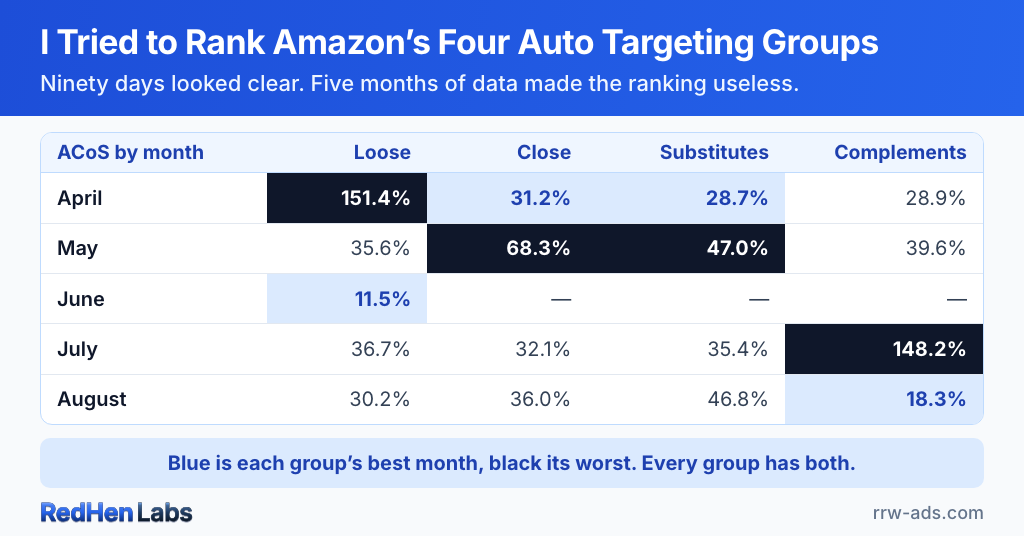
ACoS by month. June is blank for three groups because they produced no sales at all that month.
| Month | Loose | Close | Substitutes | Complements |
|---|---|---|---|---|
| April | 151.4% | 31.2% | 28.7% | 28.9% |
| May | 35.6% | 68.3% | 47.0% | 39.6% |
| June | 11.5% | — | — | — |
| July | 36.7% | 32.1% | 35.4% | 148.2% |
| August | 30.2% | 36.0% | 46.8% | 18.3% |
Every group has a month that looks like it should be killed and a month that looks like a winner.
Loose match — my best group over ninety days — burned at 151% in April and returned 11.5% in June. Complements, the supposed dog, posted the single best month of any group: 18.3% in August. Close match, the one everyone tells you to keep, spent May at 68%.
The ninety-day table wasn’t wrong. It was a window, and a different window tells a different story.
And you have blunter tools here than you do with keywords
With a search term you have precision. A term that isn’t working gets an exact negative and disappears from eligibility without disturbing anything else in the campaign (which negatives are actually worth adding).
There is no negative version of a targeting group. No negative close-match. Your practical levers are the bid and the pause button — and both operate on the entire group rather than the individual bad query or ASIN hiding inside it. That’s a real difference in granularity, and it’s why “should I turn off loose match” is a harder question than “should I negate this term.”
So don’t make it a decision. Make it a mechanism.
This is the part that actually matters. Stop asking whether close match, loose match, substitutes or complements are good. Give each one a mechanism for proving whether it deserves spend right now.
What I run is a cycle, not a verdict. A group climbs in small bid increases while it’s cheap and unproven, until it reaches my ceiling. If it has spent real money at that ceiling with nothing to show, the bid resets to about half and climbs again. Changing the bid changes which auctions and placements I’m competitive for, so a group that failed at one bid level can behave very differently at another.
Each reset is a cycle. Three cycles with zero orders and the group is paused as exhausted — it has now been tested across the full range of what I’m willing to pay and didn’t convert at any of it. That isn’t a judgment call and it isn’t the AI’s opinion; it’s a deterministic rule that runs before anything else looks at the target.
Two examples from my own account this month: a substitutes group went into the penalty box on four clicks with no orders, and a close-match group was marked exhausted on six. Those click counts weren’t the whole evidence. They were the final cycle after months of testing — each of those two groups carries 116 logged decisions going back to April, seventeen bid increases and thirteen decreases on the close-match one alone. The last six clicks only mattered because of everything before them.
That’s what replaces an answer you can’t give once. The categorical question — is loose match good? — becomes a conditional one: can loose match earn traffic at a price I’m willing to pay?
What I actually do with each
Complements stays on. It’s my cheapest group by click price and it’s genuinely cheap discovery — $90 over ninety days isn’t a number worth agonising over, and August’s 18.3% is a reminder of why I left it running.
Loose match I’ve paused more than any other group — seven times against close match’s two — and it is still my best ninety-day performer. Both of those are true at once. It can be tough. When it’s bad it’s expensive, and when it’s good it’s the best thing in the campaign.
Substitutes earns its keep differently. It feeds the product-target side of my harvesting — converting competitor ASINs graduate into a performance campaign, the same way converting search terms do (how ASIN harvesting works).
Close match is the one I think about least, which is probably the strongest thing you can say about a discovery setting.
The actual conclusion
Five months didn’t tell me which auto targeting group is best. It told me that asking which one is best is the wrong question.
I don’t need loose match to be good. I need it to earn its current bid. I don’t need complements to be bad. I need it to fail enough controlled tests before I stop paying for it.
That’s a much easier system to operate than carrying four permanent opinions about targeting groups whose performance changes every month.
Frequently asked questions
Should I turn off loose match in my Amazon auto campaign?
You can't answer that from a single window. On my own account loose match was the best of the four groups over ninety days — and inside those same five months it burned at 151% ACoS in one month and returned 11.5% in another. Every one of the four groups had a month that looked like it should be killed and a month that looked like a winner. Rather than adopting a permanent opinion, give each group a bid it has to earn and a rule that pauses it when it genuinely exhausts itself.
Can you add a negative keyword to an auto campaign targeting group?
No. There is no negative version of close match, loose match, substitutes or complements. You can negate individual search terms or ASINs inside the campaign, but the targeting group itself has only two controls: its bid and its state. Both act on the whole group rather than the specific bad query or ASIN inside it, which makes them blunter instruments than a negative keyword.
What's the difference between substitutes and complements targeting?
Substitutes places your ad on product pages for items a shopper could buy instead of yours — direct competitors. Complements places it on pages for items that go alongside yours. Substitutes is usually the more serious of the two because the shopper is already looking at your category; on my account it also feeds product-target harvesting, where converting competitor ASINs graduate into their own campaign.
How do you decide whether an auto targeting group deserves its budget?
By making it a mechanism instead of a verdict. Each group climbs in small bid increases while it's unproven, and when it reaches the bid ceiling without producing orders the bid resets to about half and climbs again — changing the bid changes which auctions and placements you're competitive for. Each reset counts as a cycle, and three cycles with zero orders pauses the group as exhausted. The question stops being 'is loose match good' and becomes 'can loose match earn traffic at a price I'm willing to pay.'
Is close match better than loose match on Amazon?
Not reliably. Over ninety days on my account loose match returned a better ACoS than close match while producing more orders, which is the reverse of the usual advice — but over five months close match spent one month at 68% and loose match spent one at 151%. Neither is dependably better. Judge each one on whether it is currently earning its bid rather than on a rule about which to keep.
Related reading
Do it step by step in RedHen Labs