Ready to automate the right way?
RedHen Labs combines rules with AI — and keeps you in control.
Why I Separate Amazon Ad Campaigns Into Discovery and Performance
I’ve built the same four-campaign structure twenty times on my own Rowdy Rooster Woodworks account. Nine are running right now. It’s also the structure my software builds by default — and I want to be precise about what it does, because the usual pitch for campaign structure is wrong.
The principle underneath it is simple: discovery and performance are different jobs, so they deserve different containers. Auto and category targeting are allowed to explore. Exact keywords and specific product targets are where proven traffic gets concentrated.
The four jobs
Two campaigns discover. Two campaigns perform.
- Auto — Amazon matches you to search terms you’d never have guessed. Discovery.
- PT Category — targets whole product categories to surface competitor ASINs worth bidding on. Discovery, for products instead of words.
- KW Performance — proven search terms, promoted to exact match, each with its own bid.
- PT Performance — proven ASINs, same idea.
Discovery feeds performance. A search term earns two or three orders in Auto and graduates into KW Performance (the harvesting workflow); a converting ASIN graduates out of PT Category into PT Performance (the ASIN version).
What it does not do: magically lower your ACoS
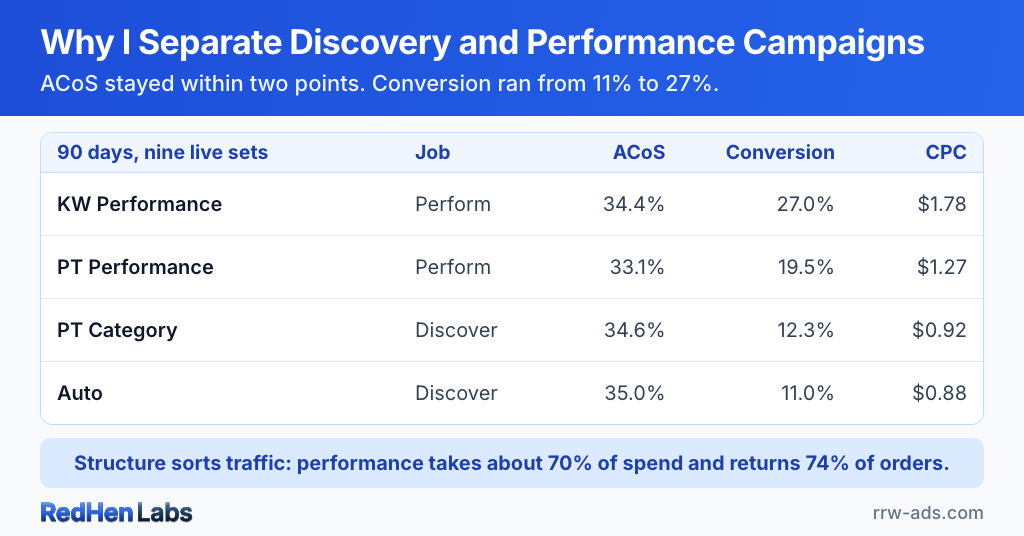
Ninety days across my nine live sets:
| Campaign | Spend | Orders | CPC | ACoS | Conversion |
|---|---|---|---|---|---|
| KW Performance | $3,313 | 501 | $1.78 | 34.4% | 27.0% |
| PT Performance | $918 | 141 | $1.27 | 33.1% | 19.5% |
| PT Category | $423 | 57 | $0.92 | 34.6% | 12.3% |
| Auto | $1,345 | 168 | $0.88 | 35.0% | 11.0% |
Four campaigns doing four different jobs, and their ACoS lands within two points of each other.
That isn’t the structure being clever. They’re all pointed at the same ACoS target — 27% on most of my automations, 30% on one — and the bid engine drives every campaign toward it by adjusting bids against actual performance. The flat line is the target being pursued. Reality settles a few points above it, which suits me: I do best somewhere around 30–35% once organic sales are in the picture.
So: structure doesn’t magically lower ACoS. In my account the bid engine largely determines where ACoS settles. The structure determines where the traffic goes and what I can do with it once it gets there.
What it does do: traffic sorting
Look at the last column instead. Harvested keywords convert at 27%. The auto campaign they came out of converts at 11%. Two and a half times better. Product targets do the same thing more quietly — 19.5% against the 12.3% category campaign that found them.
That’s what the structure buys: traffic sorting. Discovery finds the good traffic; performance campaigns give that traffic its own bid and budget. You’re taking a noisy population, identifying the members that actually buy, and moving them somewhere you can bid on them individually.
And notice the CPC column, because it’s the part that makes the flat ACoS stop being confusing. The performance campaigns don’t buy cheaper clicks — they cost twice as much per click, $1.78 against $0.88. They let me pay more intelligently for better clicks. A search that converts at 27% can support a much higher CPC than traffic converting at 11% while landing at roughly the same ACoS. That’s not a coincidence; that is exactly what rational bidding should do.
The two performance campaigns take about 70% of the spend and return 74% of the orders.
Discovery is a budget line, not a performance campaign
Auto has the worst conversion rate of the four and I have no intention of fixing it. That’s the job.
All the research in the world can’t give you the data an auto campaign can, whatever the tool sellers tell you. Real shoppers type things no keyword tool would ever suggest. You are paying for that list (more on why harvesting beats research).
So I don’t judge it primarily on ACoS. I judge it on what the spend discovers. A discovery campaign can run worse than my performance campaigns and still be worth keeping if it keeps producing targets I can harvest. When that flow dries up, its budget should dry up with it. My automations handle the slow version of that on their own — a campaign that stops producing gets cut back until it’s barely functioning, which is the right ending for a campaign whose only job was to teach me something it’s no longer teaching.
Why category targeting gets its own campaign, and stays small
PT Category is my smallest spender by a distance — $423 over ninety days against $3,313 in KW Performance. That’s deliberate. Category targeting can be like giving Amazon a blank check. You’re bidding on a category rather than a product, and the range of what it can match is enormous.
I rarely accept a bid increase on those, even when the numbers argue for one. That’s not me distrusting the math — the recommendation is correctly reading recent performance. It’s that I know the search space behind it is dangerous to expand into, and the recent numbers can’t see that. It gets its own campaign so it can be kept on a short leash without dragging on anything else.
When to retire a set
There’s no formula and I wouldn’t trust one. I retire a cluster when performance is down and it isn’t doing what I want anymore. Plenty of sellers never retire a set that still works. Both are defensible.
Your account will be messier than the diagram
I have twenty of these structures. Nine are fully live.
The rest are archived or paused — trial and error, migrating between tools, products that didn’t work out. And a couple exist because the person who built the software was testing it for the fortieth time and named a campaign CBGggg.
A real account accumulates history. The clean four-campaign diagram is how you start, not what you’ll have in two years. The point isn’t to keep the account looking like the diagram. The point is to keep knowing what job every campaign is supposed to do.
Frequently asked questions
How should I structure my Amazon PPC campaigns?
Separate the two jobs. Discovery campaigns — an auto campaign and a category-targeting campaign — exist to find search terms and competitor ASINs you would never have guessed. Performance campaigns hold the proven ones as exact keywords and specific product targets, where each gets its own bid and budget. Four campaigns per product, two discovering and two concentrating what discovery found. The structure isn't about tidiness; it's about being able to bid differently on traffic you've proven versus traffic you're still testing.
Does a better campaign structure lower your ACoS?
Not by itself. On my own account, four campaigns doing four completely different jobs all land within two points of each other on ACoS — because they're all pointed at the same ACoS target and the bid engine drives each one toward it. Structure determines where your traffic goes and what you can do with it once it arrives. Bids largely determine where ACoS settles.
What's the difference between an auto campaign and an exact match campaign?
An auto campaign is Amazon matching your ad to search terms it picks, which is how you discover what shoppers actually type. An exact match campaign holds keywords you chose, where you can set an individual bid. You can't bid on a search term in an auto campaign — only on the campaign as a whole — so a proven term has to become a keyword in a manual campaign before you can bid on it specifically.
Why keep category targeting in its own campaign?
Because category targeting can behave like a blank check. You're bidding on a whole category rather than a product, and the range of what that can match is enormous. Isolating it lets you keep it on a short leash and cap its spend without dragging on anything else — on my account it's the smallest spender of the four by a wide margin, deliberately.
How do you know if an auto campaign is worth its budget?
Not primarily by ACoS. A discovery campaign can run worse than your performance campaigns and still be worth keeping, as long as it keeps producing targets worth harvesting. Judge it on what the spend discovers. When that flow dries up, its budget should dry up with it.
Related reading
Do it step by step in RedHen Labs