The Keyword Research Myth: Why Campaign Harvesting Beats Every Tool
I sell wood-care products on Amazon under Rowdy Rooster Woodworks — cutting board oil, hard wax oil, beeswax finishes. When I started, I did what everyone tells you to: keyword research first. I typed in the obvious one — "wood finishing oil" — figured I had it covered, and built from there.
Then I read my own Search Term Report. Amazon was showing me shoppers searching "wooden finish oil," "food grade beeswax for cutting board," "oil for butcher block countertop" — phrasings I'd never have typed into a research tool. And they converted better than the term I picked.
The short version
- The Amazon Search Term Report is the most accurate keyword research available for a product, because it records real queries from real shoppers rather than estimates.
- Third-party keyword tools scrape autocomplete, estimate volume from proxy data and reverse-engineer competitor listings — all of which is guessing at what Amazon already knows.
- Over four months the Rowdy Rooster Woodworks account ran roughly 19,000 clicks and 3,900 orders, about $23,500 of spend against $74,000 in sales, and every winning keyword came from Amazon surfacing a real query.
- The head term picked by hand, "wood finishing oil", ran a 46% ACoS — barely worth running.
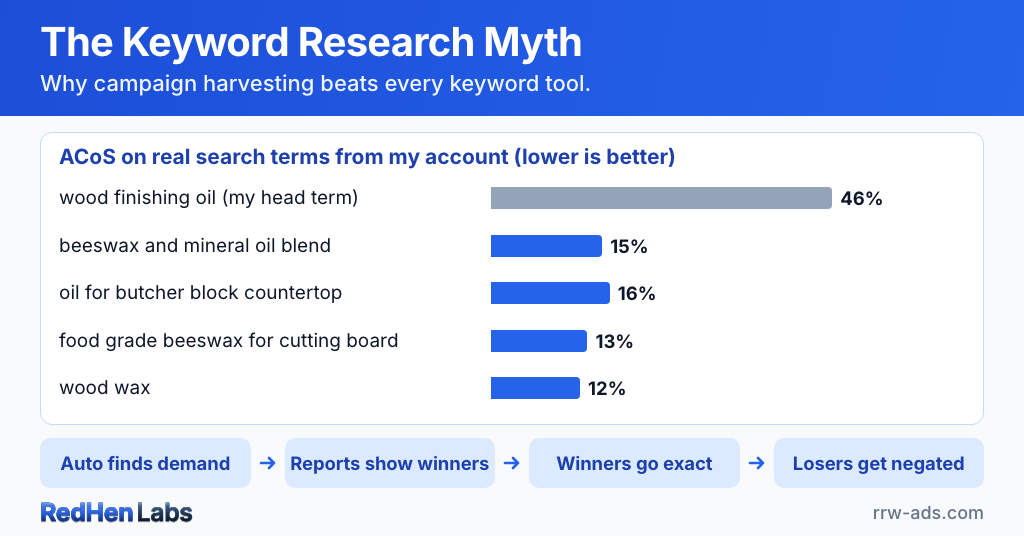
- Terms Amazon surfaced that would never have been seeded did far better: "food grade beeswax for cutting board" at 13% ACoS, "beeswax and mineral oil blend" at 15%, and "oil for butcher block countertop" at 16%.
It's backwards.
Third-party keyword tools are guessing. They scrape autocomplete, estimate search volume from proxy data, and reverse-engineer competitor listings. Some guess better than others. But none of them have what Amazon has — and what you already have, sitting in your own campaigns: the actual search data.
Amazon already knows the keywords
When you run an Auto campaign, Amazon matches your product to real queries from real shoppers — not estimates. Your Search Term Report is the most accurate keyword research that exists for your product, and it costs nothing to read. Over four months on my account that's roughly 19,000 clicks and 3,900 orders — about $23,500 in spend against $74,000 in sales. Every winning keyword in there came from Amazon showing me a real query, not from a tool.
What the report actually surfaced
My head term — "wood finishing oil," the one I'd have led with from any tool — ran a 46% ACoS. Barely worth running. The terms Amazon surfaced that I'd never have seeded did far better:
- "food grade beeswax for cutting board" — 5 orders, 13% ACoS
- "beeswax and mineral oil blend" — 7 orders, 15% ACoS
- "oil for butcher block countertop" — 4 orders, 16% ACoS
- "wood wax" — 4 orders, 12% ACoS
Three times more efficient than the keyword I'd have chosen myself. I didn't research my way to those. Amazon handed them to me.
The losers it surfaced too
The report cuts both ways. It also showed me what to stop paying for:
- "beeswax essential oil wax" — 28 clicks, zero orders, $24 gone (wrong intent — they wanted essential oils)
- "linseed oil for wood" — 15 clicks, zero orders, $15 (I don't sell linseed)
- a competitor's brand name — 13 clicks, zero orders, money I'd never have known I was spending
You don't find those in a keyword tool. You find them in your own report, and you negate them.
The harvesting loop
Put together, that's the whole strategy — and it runs in a loop:
- Auto campaigns discover demand — Amazon matches your product to queries you'd never think to target.
- Search term reports reveal what converts — not what a tool thinks might.
- Winners get promoted to exact match with controlled bids and their own budget.
- Losers get negated so you stop paying for clicks that don't buy.
Every week it tightens — not because an algorithm guessed better, but because real shoppers told you what works.
Why tools get it wrong
Keyword tools give you volume. They don't give you relevance. A term with 50,000 monthly searches means nothing if Amazon doesn't consider your product relevant to it — you'll bid, get impressions, burn budget, and wonder why nothing converts. Worse, every competitor sees the same "high volume" list, so you all bid up the same terms. Meanwhile the long-tail that actually pays — 11 clicks, 5 orders, 15% ACoS — never makes a tool's top results.
Research has its place — just not first
This isn't to say tools are useless. They're fine for a rough read on a market before launch. But I've basically stopped opening them. Amazon covers the basics, and our own campaign-creation wizard pulls the seed keywords straight from Amazon's data for the product you're advertising — so even at launch, you start from real relevance, not a tool's guess.
The best keyword strategy is the one Amazon hands you: real searches from real shoppers who found your product. Harvest it, promote the winners, negate the losers, and let it compound. That's not a hack. That's how the platform was designed to work.
Related reading
Do it step by step in RedHen Labs
Frequently asked questions
Do you need a keyword research tool for Amazon?
The Amazon Search Term Report is more accurate than any third-party keyword tool for a product already running ads, and it costs nothing to read. An Auto campaign matches the product to real queries from real shoppers, so the report records what people actually typed rather than what a tool estimated. On the Rowdy Rooster Woodworks account, every winning keyword came from Amazon surfacing a real query rather than from a research tool.
Why do Amazon search term reports beat third-party keyword tools?
Third-party keyword tools are guessing: they scrape autocomplete, estimate search volume from proxy data, and reverse-engineer competitor listings. Some guess better than others, but none of them hold what Amazon holds — the actual queries that led to clicks on your specific product. That data already sits in your own campaigns, and reading it is free.
What did the Amazon search term report surface that keyword research missed?
On the Rowdy Rooster Woodworks account, the hand-picked head term "wood finishing oil" ran a 46% ACoS and was barely worth running. The phrasings Amazon surfaced performed far better: "food grade beeswax for cutting board" at 13% ACoS over 5 orders, "beeswax and mineral oil blend" at 15% over 7 orders, and "oil for butcher block countertop" at 16% over 4 orders — roughly three times more efficient than the term chosen by hand.
Ready to automate the right way?
RedHen Labs combines rules with AI — and keeps you in control.