Amazon Ads Too Expensive? Here’s Where My Ad Money Actually Goes
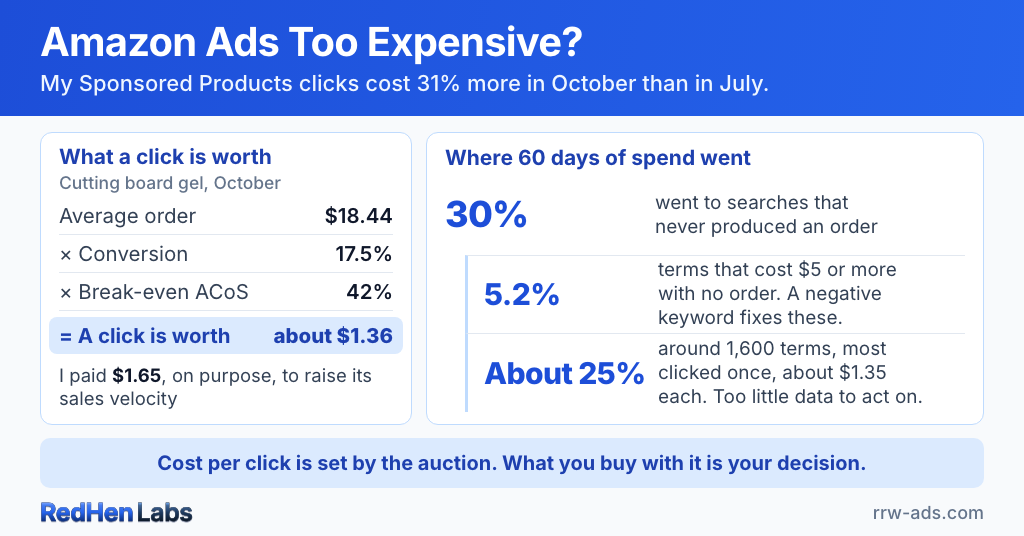
My Sponsored Products clicks cost $1.27 on average in July. In October they cost $1.66, 31% more. My Sponsored Brands clicks have more than doubled since January, from $0.79 to $1.66 in October.
Some of that is the season. Some of it is me: on a few products I’ve paid for more impressions on purpose, to push sales and Best Sellers Rank before the holidays. “Amazon ads are too expensive” is usually two questions tangled together: what a click costs, and how much of what you buy turns into anything.
The short version
- On my account, Sponsored Products clicks averaged $1.27 in July 2026 and $1.66 in October, 31% more; Sponsored Brands clicks went from $0.79 in January to $1.66 in October.
- Part of a rising cost per click is the season and part can be deliberate: I paid for more impressions on a few products to push sales and Best Sellers Rank.
- A click is worth at most average order × conversion rate × break-even ACoS: about $1.36 on my cutting board gel in October. I paid $1.65, on purpose, to raise its sales velocity.
- Over 60 days about 30% of my spend went to search terms with no order, but only 5.2% to terms that cost $5 or more, which is what a negative keyword fixes; the rest was about 1,600 terms clicked about once each.
- I bid on my own brand name out of competitor fear and have not tested pausing it; 33 of my 34 Sponsored Products campaigns use dynamic bids down only.
What a click is worth
Every click has a ceiling: your average order × your conversion rate × your break-even ACoS. On my cutting board gel in October, that’s $18.44 × 17.5% × 42%, about $1.36. I paid $1.65, on purpose: I’m working to raise the gel’s sales velocity, and that premium is what it costs. (The gel’s math, line by line.)
That’s the honest way to read a rising cost per click. If you’re over the ceiling, you’re either buying something on purpose (rank, a launch, a holiday push) or losing money by accident. Know which one it is.
The expensive middle: searches with too little data
Over the last 60 days, about 30% of my ad spend went to search terms that never produced an order. That sounds terrible. It’s less simple than it sounds.
Only 5.2% of my spend went to terms that cost $5 or more without an order. That’s what our free Waste Calculator counts as waste, and what a negative keyword fixes. Most accounts run 8–15%.
The other quarter went to about 1,600 different search terms, most of them clicked once, at about $1.35 each.
That’s the toughest thing we deal with as advertisers. The intent behind those searches is nebulous. There isn’t enough data to act on any one of them, and together they’re expensive anyway. Hope plays a part too: some of them will convert on the next click, and nobody can tell which.
What I do:
- Negate a term once it has cost real money without an order, not before. (The three gates I use.)
- Move terms that do convert into their own exact-match campaigns, so proven traffic doesn’t share a budget with discovery. (Discovery and performance are different jobs.)
- Treat the rest as the cost of finding new customers, and keep it in a budget I chose instead of one I found out about.
My own brand name
I bid on searches for my brand name. Over the last 90 days those clicks cost $0.95, well under my average, and 43% of them became orders, at a 10% ACoS.
Why I do it: competitor fear. If I’m not at the top of a search for my own name, someone else can be.
What I haven’t done is test it. The honest version of this advice: pause the brand campaign for two weeks and watch whether orders on those searches hold up without the ad. If they hold, you were paying for customers who had already found you. If they drop, the spend was doing a job. I should run that test on my own account.
How much control I give away
33 of my 34 Sponsored Products campaigns use “Dynamic bids – down only.” With “up and down,” Amazon can raise your bid by up to 100% at the top of search, and by up to 50% elsewhere, when it predicts a sale. I don’t use it. I’m averse to handing over more control than I have to. The algorithm doesn’t know my margins, and when a raised bid doesn’t pay off, the bill is mine. (How placement bids stack on top of it.)
What I built
RedHen Labs works the way I do. The AI’s suggestions wait for my approval; auto-apply is off unless I turn it on, and even then it only makes small bid moves. Negatives come from terms with real spend behind them, and proven terms move into their own campaigns. The Waste Calculator counts only what a negative list can fix: terms that cost $5 or more without an order.
What to do this week
- Compare your average cost per click month by month. If it’s rising, decide whether you’re paying for it on purpose.
- Run your 60-day search term report through the Waste Calculator. Fix what it flags, and don’t chase one-click terms.
- If you bid on your own brand name, write down why. Then test it.
Cost per click is set by the auction. What you buy with it is your decision. RedHen Labs keeps those decisions in your hands.
Related reading
Do it step by step in RedHen Labs
Frequently asked questions
Why are Amazon ads so expensive?
More sellers bid in the fourth quarter, so clicks cost more, and some of the increase can be your own choice. On my account Sponsored Products clicks cost 31% more in October 2026 than in July, partly because I paid for more impressions to push sales and Best Sellers Rank on a few products. Check whether a rising cost per click is something you are buying on purpose.
What is the most I should pay per click on Amazon?
Average order value × conversion rate × break-even ACoS. On my cutting board gel in October 2026 that was $18.44 × 17.5% × 42%, about $1.36 a click. Paying more only makes sense on purpose, for example to raise a product's sales velocity, and it should be a decision rather than an accident.
Should I bid on my own brand name on Amazon?
Test it rather than assume. Pause your brand campaign for two weeks and watch whether orders on your brand searches hold up without the ad. I bid on mine out of competitor fear: over 90 days those clicks cost $0.95 and 43% became orders, at a 10% ACoS, and I have not yet tested pausing it.
Should I use Amazon's dynamic bids up and down?
Only if you are comfortable letting Amazon raise your bid without knowing your margins: up and down can raise it by up to 100% at the top of search and up to 50% elsewhere. I keep 33 of my 34 Sponsored Products campaigns on dynamic bids down only, so a raised bid is always my decision.
Ready to automate the right way?
RedHen Labs combines rules with AI — and keeps you in control.