Amazon Product Research: Why Everyone Lands in the Same Niche
This is the third of four articles on the Amazon guru landscape. The first was about the courses, the second about wholesale and arbitrage. This one is about product research: the courses and tools that promise to find you a winning product.
I don’t find products that way. I’m a manufacturer and a brand owner, and I control my products from concept to market: the idea, testing for market fit, lab testing, package design and production. But I sell in a niche the research tools like, cutting board oils and wood finishes, so I see what happens when they all point at it.
The short version
- Product research tools and courses teach the same public filters, so thousands of sellers land on the same short list of products and a niche fills up all at once.
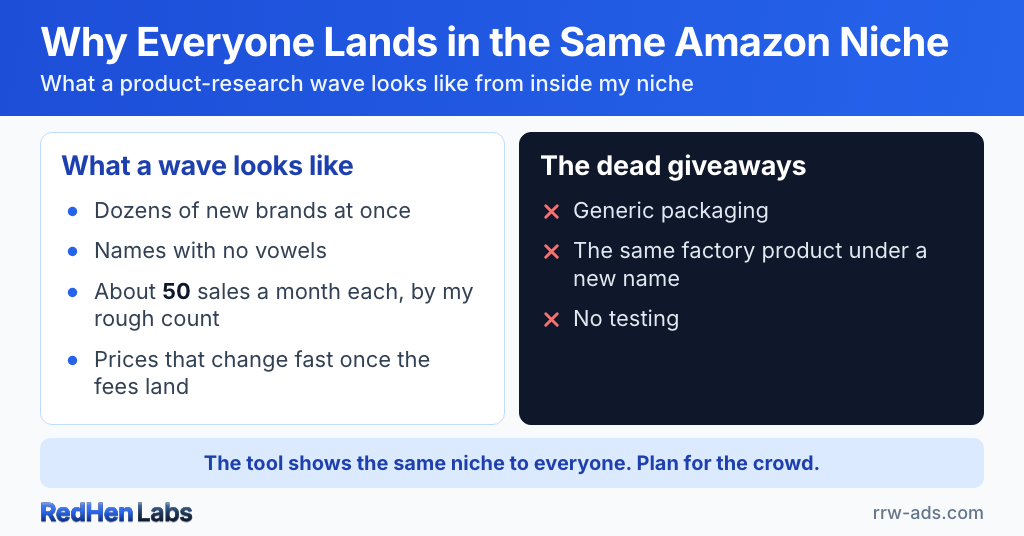
- From inside my niche, a wave looks like dozens of new no-name brands at once, with names of capital letters and no vowels, each taking something like 50 purchases a month by my rough count.
- Generic packaging, the same factory product under a new name and no testing are the giveaways; for a product that touches a cutting board, quality control matters.
- The waves bid on the same family of searches, spend to rank and leave when the money runs out, so the ad auction stays more expensive than it needs to be.
- During a wave I do nothing: I weather the auction and keep my place in units sold per month, because sales hold a listing's rank.
Everyone runs the same filters
Product research comes down to filters: a search with enough sales, not too many reviews, a price that leaves room. The criteria are taught in public, so thousands of people run the same filters and land on the same short list of products. A niche doesn’t get found by one person. It gets found by a crowd, all at once.
What a wave looks like from inside the niche
It starts with a sudden increase in no-name brands, or pretend brands. You’ve seen the names: strings of capital letters with no vowels. My guess is that a made-up name like that makes the trademark and Brand Registry application easy, and it makes the brand easy to walk away from. At the first problem it disappears, and the customer is left holding the bag.
The dead giveaways are generic packaging, the same factory product under a new name, and no testing. For a product that goes on a cutting board, that matters: no real quality control, and sometimes ingredients I’d question.
There will be dozens of them at a time. By my rough count, each one siphons off something like 50 purchases a month. None of them is big. Together they’re a lot of sales that used to go to brands that will still be here next year.
Not everyone in the wave is cutting corners
A lot of them are honest people trying to build something, and that’s how I’d want to be judged too. You can usually tell when they’ve been bitten by Amazon’s fees: their pricing changes fast. A product launched at one price is at another a few weeks later, once the referral fee, the fulfillment fee and the ad bill have all landed on the same unit. That’s the part the research tools skip. They show revenue, not what’s left of it.
What the waves do to the ad auction
Every new seller has the same plan: spend on ads to rank. Dozens of them bidding on the same family of searches pushes the auction up for everyone. It hits all of my searches at once, because they’re one family: walnut oil, cutting board oil, cutting board wax, mineral oil. Then they run out of money and leave, and the next group arrives. So the auction is always more expensive than it needs to be. Most of them leave with nothing to show for it, and what they spent stayed in the auction.
On my biggest typed search, “walnut oil for wood,” I paid $1.62 a click in May and $2.62 in October. Some of that is my own bidding, and I can’t tell you how much is the waves. What I can tell you is that a click there costs what the crowd is willing to pay, and the crowd keeps changing.
What I do during a wave: nothing
I don’t do anything. I weather the ad auction and try to keep my place in units moved per month. Sales are what hold a listing’s rank, and rank is what’s still there when the wave has moved on.
Cutting my bids to wait them out would hand them the clicks. Chasing them would mean paying their prices. Holding steady costs something too, but it’s the cost of still being here.
If you’re the one doing the research
- Everyone else ran the same filters. If the tool found it, so did a crowd. Plan for the crowd, not for the empty niche in the screenshot.
- Revenue isn’t what’s left. Work out what one sale leaves after Amazon’s fees, product cost and ads before you order inventory. On my products, break-even ACoS runs from 27% to 49%.
- A brand is a commitment. If the plan only works while nothing goes wrong, the customer pays when something does.
Where I land
Product research isn’t wrong. I research my products too, just from the shop instead of from a filter. What the courses leave out is that the tool shows the same niche to everyone, and that the customers and the brands already in that niche pay for the waves that pass through. The fourth article is about building a brand that outlasts them.
Frequently asked questions
Why do Amazon product research tools lead everyone to the same products?
Because everyone runs the same filters: a search with enough sales, not too many reviews and a price with room in it. The criteria are taught in public, so thousands of people land on the same short list at once, and a niche fills up with a crowd rather than one newcomer.
Why are there so many unknown brands with random letter names on Amazon?
In my niche they arrive in waves. My guess is that a made-up string of letters is easy to register and easy to walk away from, and many of those brands disappear at the first problem, leaving the customer holding the bag. Generic packaging, a renamed factory product and no testing are the giveaways.
Do new sellers make Amazon ads more expensive?
More bidders on the same searches push up the price of a click for everyone in the auction. In my niche the waves bid on the same family of searches, spend to rank and leave when the money runs out, and then the next group arrives. I can't separate how much of my own click prices that explains, but the auction stays more crowded than it needs to be.
What should an established brand do when new sellers flood its niche?
What I do is hold steady. I weather the ad auction and try to keep my place in units sold per month, because sales hold a listing's rank. Cutting bids hands them the clicks, and chasing them means paying their prices.
How can you tell a real brand from a product-research seller on Amazon?
Look for generic packaging, the same factory product sold under different names, and no sign of testing. A real brand controls its product from the formula to the package, and it's still there when something goes wrong.
Related reading
Ready to automate the right way?
RedHen Labs combines rules with AI — and keeps you in control.