Wholesale and Arbitrage on Amazon, From the Brand Owner’s Side
This is the second of four articles on the Amazon guru landscape. The first was about the courses. This one is about two of the business models they sell most: wholesale and arbitrage.
Both come down to the same move: buy someone else’s branded product and sell it on Amazon, usually on the listing the brand already built. It’s legal, and for a lot of people it’s a living. I make my own products, so I see it from the other side of the listing.
The short version
- Wholesale, arbitrage and liquidation sellers all resell someone else's branded product, usually on the listing the brand built, sharing its page, reviews and buy button.
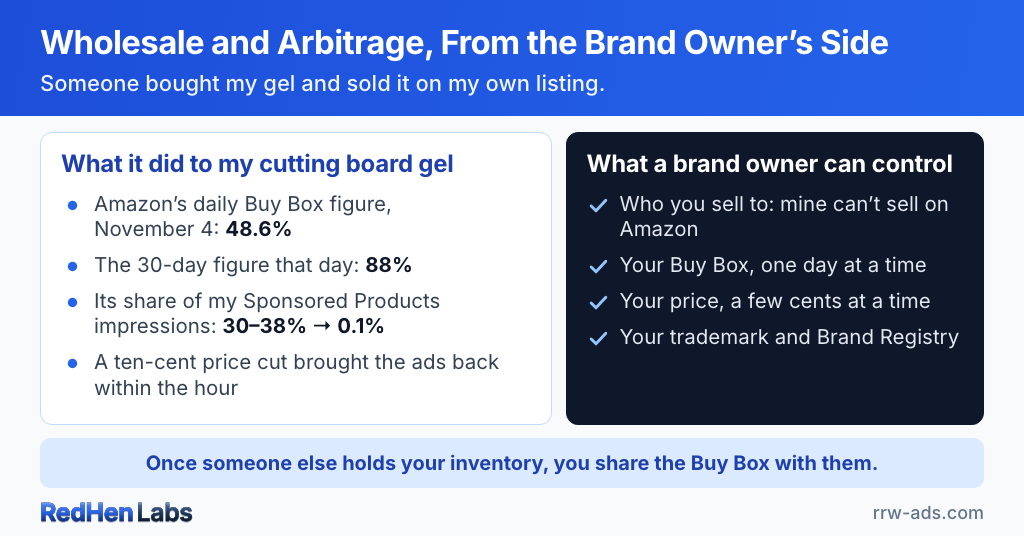
- On my cutting board gel, a seller who bought stock from me won the Buy Box: Amazon's daily figure showed me at 48.6% on November 4 while the 30-day figure read 88%.
- Sponsored Products only shows while you hold the featured offer, so the gel's share of my Sponsored Products impressions fell from 30–38% to 0.1%; a ten-cent price cut brought the ads back within the hour.
- My rule now: whoever I sell to, stores included, isn't allowed to sell on Amazon. Once someone else holds your inventory, you share the Buy Box with them.
- Product reviews belong to the product, so a returned or damaged unit resold to an unhappy shopper becomes a review on the brand's listing.
How the models work
Wholesale sellers buy in bulk from the brand or a distributor and resell. Arbitrage sellers buy at retail, on clearance or online, and resell for more. Liquidation sellers buy pallets of returns and overstock. The courses teach all three as a way to start without making anything.
What they share is the listing. When several sellers offer the same product, they share one product page, one set of reviews and one buy button. Amazon shows one seller’s offer as the featured offer, and the rest sit behind it. That featured offer is what the courses call winning the Buy Box.
What it looked like on my cutting board gel
Someone bought a quantity of my gel from me. I assume they reached me through my website. At the time I thought it was a good idea. In hindsight it has likely cost me more than I ever made from it.
In early November they started winning the Buy Box on my listing. Amazon’s own daily figure for November 4 put me at 48.6% of the gel’s page views, while its 30-day figure still read 88%. Sponsored Products ads only show while you hold the featured offer, so my gel’s share of my Sponsored Products impressions went from 30–38% in late October to 11% on November 4 and 0.1% on the morning of November 6. My Sponsored Brands ads kept running the whole time, sending shoppers to a page where the other seller had the buy button.
I dropped the price ten cents, from $17.89 to $17.79, and the ads were back within the hour. A ten-cent cut had fixed the same thing in October. Every one of those cuts comes out of my margin, a few cents at a time.
My rule now: nobody I sell to sells on Amazon
I sell to stores, and I’m glad to. But whoever I sell to, I don’t allow Amazon selling. Once someone else holds your inventory, you share the Buy Box with them, and you can’t take that back.
If you own a brand, decide who sells it on Amazon before someone decides for you. The time to say no is before the stock leaves your building.
Is reselling fair?
I suppose that’s their game. Go for it. Buying a product and selling it for more is about as old as trade.
Where it can do damage is with stock that shouldn’t be sold as if it were new. Returned and damaged units get sold off at a discount, and some of them can end up back in front of shoppers through a reseller. The shopper gets a product that isn’t right, and the review lands on my listing, not the reseller’s. Product reviews belong to the product. The reseller moves on; the review stays with my brand.
An unauthorized seller in Canada
Before I sold in Canada, someone else was already selling my products there. That’s part of why I expanded: if my product is going to be on that shelf, I’d rather be the one who put it there. Now I sell there myself, and my price is lower than theirs. I hope they stop.
What a brand owner can control
- Who you sell to, and on what terms. Mine is simple: no Amazon selling.
- Your Buy Box, one day at a time. A 30-day figure of 88% hid a day at 48.6% on my gel. Seller Central’s Business Reports show it per product if you pick a single day.
- Your price. The featured offer often follows price. A small cut can win it back, but matching a reseller cent for cent is margin you don’t get back.
- Your trademark and Brand Registry. They don’t stop every reseller, but they’re a deterrent. More on that in the fourth article.
Where I land
Wholesale and arbitrage are legitimate ways to make money, and the courses aren’t wrong that people make it. What they leave out is who’s on the other side of the listing: a brand owner who built it, and a shopper who expects the product the brand makes. If you’re a reseller, buy from brands that want you there. If you’re a brand owner, choose who sells your product on Amazon before someone else does.
Next in this series: product researchers, and why the ad auction in a popular niche costs more than it needs to.
Frequently asked questions
What's the difference between wholesale and arbitrage on Amazon?
Wholesale sellers buy in bulk from a brand or distributor and resell. Arbitrage sellers buy at retail, on clearance or online, and resell for more. Both usually sell on the listing the brand already built, sharing its product page, reviews and buy button with the brand and any other sellers.
Can another seller sell my brand's product on Amazon?
Usually, yes, if they have genuine stock: a seller who buys your product can list it on your existing listing, and Amazon can give them the featured offer. The practical control comes earlier, in who you sell to and on what terms. Mine is that no one I sell to may sell on Amazon. A trademark and Brand Registry help as a deterrent.
Why did I lose the Buy Box on my own product?
Because another seller offers the same product and Amazon chose their offer, often on price. On my cutting board gel the other seller had bought stock from me. Amazon's daily figure showed me at 48.6% on November 4 while the 30-day figure read 88%, and a ten-cent price cut brought my ads back within the hour.
Do reviews from a reseller's customers affect my brand?
Yes. Product reviews belong to the product, not to the seller, so a shopper who receives a returned or damaged unit from a reseller reviews your listing. Seller feedback is separate, but shoppers read the product reviews.
How do I stop wholesale buyers from selling my products on Amazon?
Decide before the stock leaves your building. I sell to stores, but whoever I sell to isn't allowed to sell on Amazon. Once someone else holds your inventory, you share the Buy Box with them, and that's hard to undo.
Related reading
Ready to automate the right way?
RedHen Labs combines rules with AI — and keeps you in control.