Are Amazon Seller Courses Worth It? Why I Never Bought One
I make wood finishing products (a cutting board gel, oils, waxes and a hardwax oil) and sell them on Amazon, on Walmart, in stores and on my own website. I’ve never bought an Amazon course. That wasn’t a principle at first. When I started, the guru content was so thick that I gave up on all of it. There was too much to filter through, and there still is.
This is the first of four articles about the Amazon guru landscape and what it does to the people selling there: resellers, wholesalers, product researchers and brand owners like me. This one is about the advice itself.
The short version
- I've never bought an Amazon course: when I started, the guru content was so thick I gave up on all of it, and I'd tell most new sellers to skip them.
- My test: advice that ends with the seller paying the adviser is probably wrong, because the incentive points at your wallet, not your business.
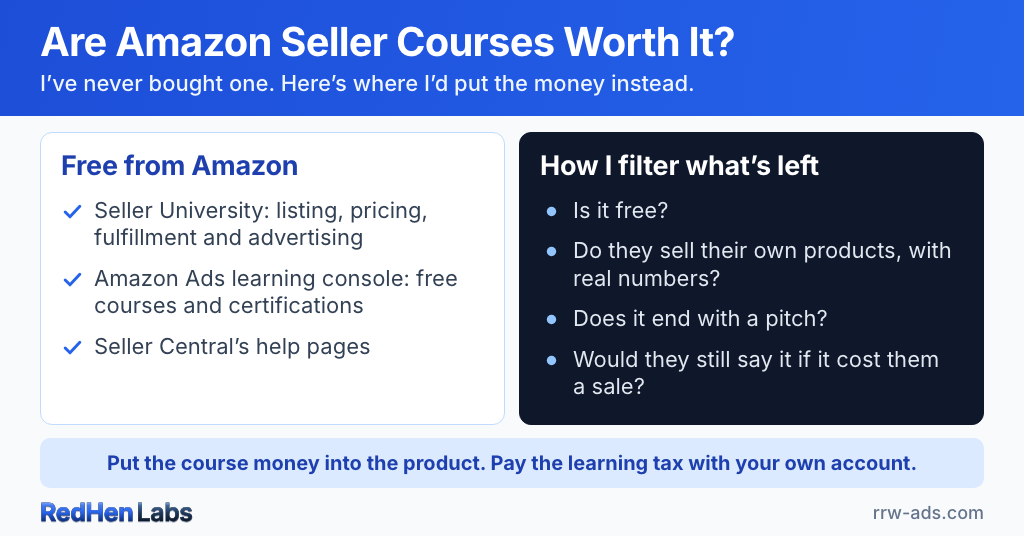
- Amazon's Seller University and the Amazon Ads learning console are free, and Seller Central's help pages answer most of the rest.
- Course money does more in the product: concept, market testing, lab testing, packaging and production all show up in what a customer holds.
- Rules of thumb like keeping ACoS under 25% fit nobody in particular: break-even ACoS on my products runs from 27% to 49%.
The problem isn’t one bad course. It’s the volume.
Some of the people selling Amazon education probably do want to help. The trouble is that you can’t tell which ones. Search a basic question about selling on Amazon and a lot of what comes back is someone with something to sell: a course, a coaching call, a mastermind, a tool with a course bundled in.
That volume works like a wall. The good free information is out there. It’s behind so much pollution that most new sellers never get to it, and a new seller is the person least able to tell the difference.
My test: does the advice end with you paying the adviser?
I treat any guru advice that ends with the seller paying the guru as probably wrong. Not always. But the incentive points at your wallet, not your business, and you can’t see which way they’d steer you if the honest answer cost them a sale.
It’s the same pattern I found when I looked at who pays for PPC advice: reviews funded by affiliate commissions, podcast spots that are bought, and a $997 course bundled into a software subscription.
Yes, I sell software too, so hold me to the same test. Our price is flat and printed on the pricing page, and nothing in this article is behind a sign-up.
Amazon will teach you most of what you need, for free
Amazon’s Seller University is free and open to anyone, with or without a selling account. It covers listing, pricing, fulfillment and advertising. For ads, Amazon’s learning console has free courses and certifications. Seller Central’s help pages answer most of the rest.
None of it is exciting, and it isn’t meant to be. It’s how the marketplace works, from the people who run it.
Put the course money into the product
A new seller is almost always better off spending course money on developing a product, or a product line.
I control my products from concept to market: the idea, testing whether there’s a real market for it, lab testing, package design and production. Every one of those steps costs money, and every one shows up in the product a customer holds. A course shows up nowhere a customer can see.
A $997 course is $997 not spent on a better formula, a lab test, or packaging that stands out next to everyone else’s.
Expect to pay a learning tax
My advice to a new seller is simpler than anything a course sells: start doing, expect to pay some learning tax, and read the free material. There’s plenty of it.
I paid mine. I’d been selling for a couple of years before I built my own ad tool, and I paid the ads learning tax in full: wasted spend, campaigns that looked fine and quietly lost money, search term reports I didn’t understand yet.
The difference is what it bought. My learning tax taught me my own products and my own account. A course would have taught me someone else’s.
Rules of thumb that fit nobody in particular
The advice that spreads fastest fits in one sentence. “Keep your ACoS under 25%” is the one I hear most. On my products, break-even ACoS runs from 27% to 49%. A rule that sounds safe is too cautious for me, and it can still lose money for a reseller on thin margins. Work out your own number from your own margins.
What the hype does to everyone else
The cost doesn’t stay with the people who buy the course. In my niche we see it again and again: product researchers find a product, think they’ll get rich in it, spend on ads to rank, run out of money, and then more of them come. Each wave makes the ad auction more expensive than it needs to be for everyone in it, and most of them leave with nothing to show for it. That’s the third article in this series.
How I’d filter what’s left
- Is it free? Most of what a new seller needs is.
- Does the person sell their own products, and show real numbers from them?
- Does it end with a pitch? If the useful part is the teaser and the answer is behind a payment, it’s a sales page.
- Does it say “it depends” where it should? Margins, fees and categories differ. Advice that’s the same for everyone fits no one.
- Would they still give it if it cost them a sale?
Where I land
I’m not against learning. I’m against paying someone to stand between you and information that’s free. Spend the money on your product, pay the learning tax with your own account, and read what Amazon publishes.
Next in this series: wholesale and arbitrage, from the side of the brand owner whose listings they sell on.
Frequently asked questions
Are Amazon seller courses worth it?
For most new sellers, no. Amazon's own Seller University and the Amazon Ads learning console are free, and the course money usually does more in the product itself. Some paid education may be good, but it's hard to pick out from the rest, and advice that ends with you paying the adviser has an incentive pointed at your wallet.
Where can I learn to sell on Amazon for free?
Amazon's Seller University, which is free and open to anyone, even without a selling account; the Amazon Ads learning console, with free courses and certifications; and Seller Central's help pages. Add what your own account teaches you, and expect to pay some learning tax along the way.
How do I tell good Amazon advice from a sales pitch?
Ask five questions. Is it free? Does the person sell their own products and show real numbers from them? Does it end with a pitch? Does it say “it depends” where margins, fees and categories differ? Would they still give the advice if it cost them a sale?
What should a new Amazon seller spend money on instead of a course?
The product. Developing it takes a concept, testing whether there's a real market, lab testing, package design and production, and every one of those shows up in what a customer holds. A $997 course is $997 not spent on any of them.
Is the 25% ACoS rule right?
Only by coincidence. The right ceiling is your own break-even ACoS, set by your price, fees and costs. On my products it runs from 27% to 49%, so 25% is too cautious for me and can still lose money for a reseller on thin margins.
Related reading
Ready to automate the right way?
RedHen Labs combines rules with AI — and keeps you in control.