Buyer-Seller Messaging vs Request a Review: Which Should You Use?
Amazon gives sellers two ways to reach a buyer after a sale. Request a Review is Amazon’s own fixed message. Buyer-Seller Messaging is a message you write yourself. I use both, for different jobs.
Request a Review goes out automatically on my orders. Messaging I use rarely: when a bad review comes in, I message the buyer to see if I can put the problem right. I don’t think I’ve ever asked for a review in a message.
The short version
- Request a Review is Amazon's own fixed message asking for a product review and seller feedback; Buyer-Seller Messaging is a message you write yourself, meant for the order.
- I send Request a Review automatically, and I don't think I've ever asked for a review in a message.
- I message a buyer on the rare occasion a bad review comes in, to see if I can put the problem right; Amazon doesn't allow asking them to change or remove the review.
- In a message you can ask for a review once per order, but not for a positive one, and not again if Request a Review already went out.
- For reviews, Request a Review is safer: there's nothing in Amazon's message to break the rules.
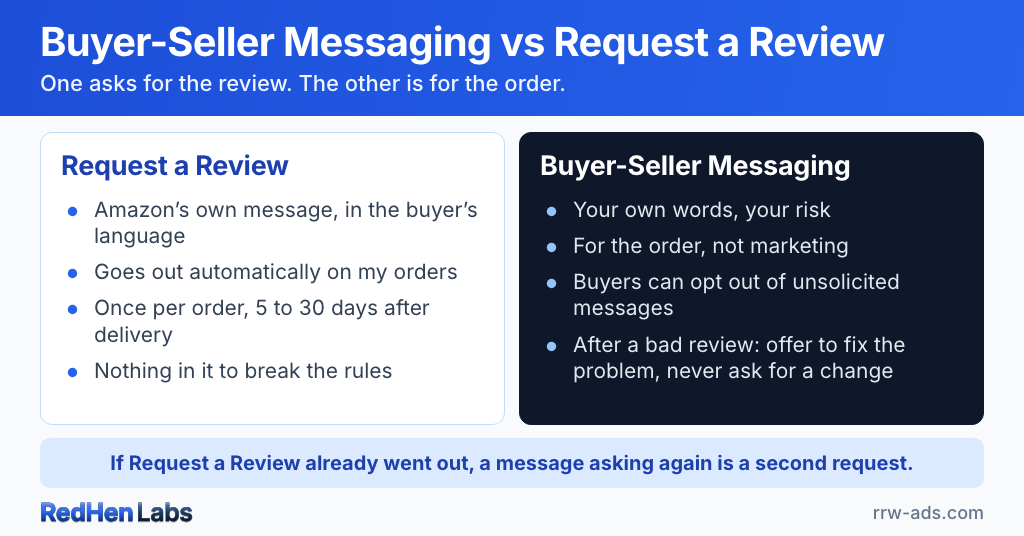
Request a Review: the ask
One click in Seller Central, or one call through Amazon’s Solicitations API, sends Amazon’s standard message asking for a product review and seller feedback, in the buyer’s language. You can’t change a word or attach anything, and it goes out once per order, 5 to 30 days after delivery. For the job of asking every customer for a review, safely, that lack of control is the point. (How I automate it.)
Buyer-Seller Messaging: the order
Messaging is for the order itself: a shipping question, a problem, a return. You write it, so you own every word, and the rules are tighter than many sellers think:
- It’s for messages about the order, not marketing.
- Buyers can opt out of unsolicited messages.
- You can ask for a review once per order. You can’t use wording that pushes for a positive one, and you can’t ask again.
- Pressuring buyers, or chasing only the happy ones, can get your messaging restricted, or worse.
When a bad review comes in
This is the one time I reach out on my own. I message the buyer to see if I can put the problem right.
What I can’t do is ask them to change or remove the review, or offer anything for doing so. Amazon doesn’t allow that, even after the problem is fixed. The rule I keep in mind: you can ask for a review; you can’t ask for a good one.
Which to use for reviews
Request a Review, for almost everyone. It’s Amazon’s message, so there’s nothing in it to break the rules, there’s no copy to write, and it can run on every order without you. Amazon allows one review request per order, so if Request a Review already goes out, a message asking again is a second request. Keep messaging for the order itself.
That’s how RedHen Labs works: Amazon’s own Request a Review only, on every eligible order, no messages in the loop, and real profit per product alongside it, for $19 a month. See the Review plan →
Frequently asked questions
What's the difference between Buyer-Seller Messaging and Request a Review?
Request a Review is Amazon's own fixed message asking for a product review and seller feedback, sent once per order, 5 to 30 days after delivery. Buyer-Seller Messaging is a message you write yourself, meant for questions and problems with the order, and buyers can opt out of unsolicited ones.
Which is safer for asking for reviews?
Request a Review. The message is Amazon's, so there's nothing in it to break the rules. A message you write yourself can break them with one phrase, such as asking for a positive review.
Can I message a buyer who left a bad review?
You can message them about their order to try to put the problem right. You can't ask them to change or remove the review, or offer anything for doing so, even after the problem is fixed. On the rare occasion I get a bad review, that's what I do.
Can I ask for a review in a Buyer-Seller message?
Once per order, in neutral words: you can ask for a review, not for a good one. If Request a Review already went out on that order, a message asking again is a second request. I use Request a Review for asking and keep messages for problems.
Related reading
Ready to automate the right way?
RedHen Labs combines rules with AI — and keeps you in control.