How to Throttle Your Amazon Ads Before a Stockout (and Why Running Dry Costs You Rank)
Here’s a mistake I’ve watched sink other sellers, even though it’s never gotten me: they advertise a product hard, it takes off, and they pour gas on it right up until the day it runs out of stock. The listing goes dark, and when they finally restock, the sales don’t come back the way they left. The ads were working. That was the problem.
I sell wood-finishing products under Rowdy Rooster Woodworks, and the reason this one has never bitten me is partly that I manufacture my own goods, so I can replenish fast. But I’ve seen it happen, and it isn’t pretty — and it almost always traces back to the same place as the cash-flow gap I wrote about before: a product takes off, the money’s tied up in Amazon’s reserve, you can’t fund the next production run in time, and you advertise straight into a wall you couldn’t afford to avoid.
Running dry isn’t a sales problem. It’s a rank problem.
Most people think a stockout costs you a few days of sales. Annoying, but you make it up when you restock, right?
Not quite. When you go out of stock, Amazon loses one of the signals it most prefers from a seller: consistent availability. And sellers routinely watch their organic rank and Buy Box share slide after a stockout — the catch being that, unlike the sales you lose while you’re out, that decline doesn’t snap back the day you restock. You spent months and real ad dollars building that rank. A hard stockout quietly hands some of it back.
That’s what makes this worth automating. You’re not protecting a few days of sales. You’re protecting the rank.
The fix: ease off the ads before zero, not at zero
Amazon will eventually pause your Sponsored Products ads when a product hits zero — but that’s reactive. By the time it kicks in you’re already out, the slide has already started, and it only covers Sponsored Products, not your other ad types.
The move is to act before zero. As a product you’re advertising gets low on stock, you ease off the ads — slow the burn so the remaining units stretch, and glide to your restock date instead of slamming into a wall. You’re not trying to save the ad spend; that’s a nice side effect. You’re trying to keep the availability you’ve got, so the rank you built stays put.
How I have it set up
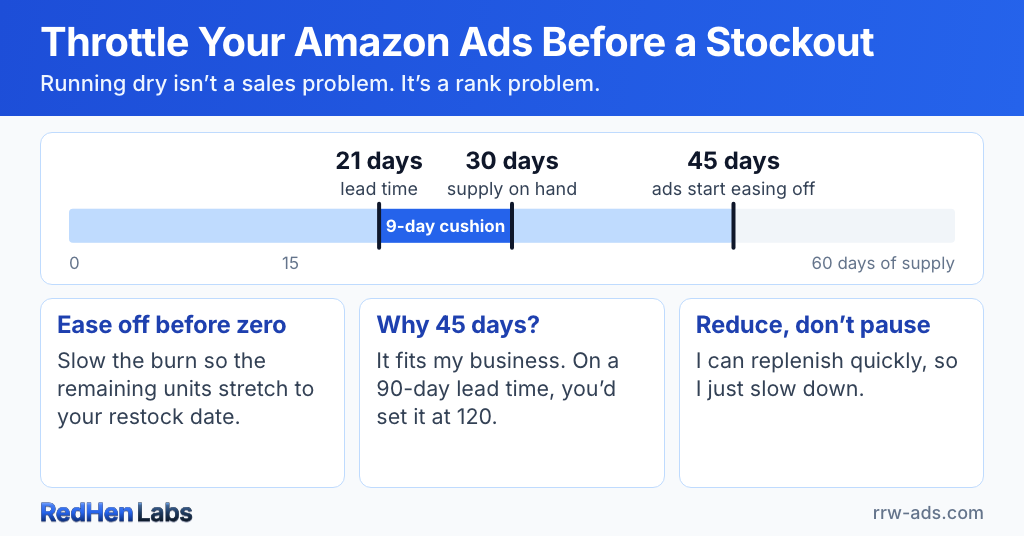
I run this on my own account. RedHen’s inventory automation reads the days of supply for each product and, when one drops below a threshold I set, reduces the bids on that product’s keywords and targets — then automatically puts them back when I restock above the recovery line. Mine is set to 45 days, action reduce bids (not pause).
Reorder lead time: 21 days
Throttle threshold: 45 days
→ Ads already easing off (30 is under 45), with 9 days of cushion beyond your lead time — you never get near zero.
Two deliberate choices there, both about my business:
Why 45 days? It’s tuned to my lead time. It takes about a week to produce a batch and another two before the units show as available on Amazon — call it three weeks, door to shelf. Forty-five days of supply gives me comfortable runway to notice, produce, and ship before I’d ever actually run dry. If you’re sourcing overseas on a 90-day lead time, 45 days is far too late — you’d set it at 120 and start easing off much sooner. The right threshold is your replenishment speed, which is exactly why it’s a rule you set, not a number we pick for you.
Why reduce, not pause? Because I can replenish quickly, so I don’t need to slam the brakes — just slow down. Reducing bids keeps me visible and defending my rank while stretching the inventory. A seller with a long, unreliable supply chain might choose a hard pause instead, because for them the risk of running fully dry is worse than going quiet for a while. Same tool, opposite setting, both right.
Why this isn’t a “set it and forget it” feature
Running dry is purely an algorithm pitfall — one every seller needs to avoid, no exceptions. But how you avoid it depends entirely on how fast you can restock, and that’s not something software can guess. So the threshold, the action, and the recovery point are all yours to set, and every change waits for your approval.
This is the one automation argument I never have to oversell. With PPC, plenty of people figure they’ll just manage it themselves — fair enough. But monitoring every SKU’s days of supply, every single day, and catching the one quietly counting down while you’re busy looking at ACoS? Nobody keeps that up by hand for long. The software handles the vigilance; you keep the judgment.
The takeaway
The most expensive inventory you own is the inventory you let run out while you were paying to sell it faster. A stockout on a product you’re actively advertising is the worst of both worlds: you spent money accelerating toward the wall, and the wall costs you the rank you were building. So watch days of supply on the products you advertise, set a throttle threshold that matches how fast you can actually restock, and ease off before zero — not to save the clicks, but to hold the availability and the rank that come with it. See your real numbers — free for 14 days.
Frequently asked questions
Does running out of stock hurt your Amazon ranking?
It can. When you go out of stock you lose the consistent-availability signal Amazon favors, and sellers routinely see organic rank and Buy Box share slide after a stockout. Unlike the sales you lose while you're out, that decline doesn't fully snap back the day you restock — which is why it's worth avoiding the stockout in the first place, not just recovering from it.
Should you reduce or pause Amazon ads when a product is low on stock?
Either, depending on how fast you can restock. If you replenish quickly, reduce bids — it keeps you visible and defending your rank while stretching the remaining units. If you have a long, unreliable supply chain, a hard pause can be safer, because running fully dry is worse than going quiet for a while. Match the action to your lead time.
Doesn't Amazon already pause ads when you run out of stock?
Amazon pauses Sponsored Products when a product hits zero, but that's reactive — by then you're already out and the ranking slide has started — and it only covers Sponsored Products, not your other ad types. The point of an inventory-aware throttle is to ease off before you reach zero, not after.
What days-of-supply threshold should trigger an ad throttle?
Set it to your replenishment lead time plus a buffer. If it takes about three weeks to restock, a 45-day threshold gives comfortable runway; if you source overseas on a 90-day lead time, you'd set it closer to 120 days and start easing off much earlier. The threshold should reflect how fast you can actually get more units in stock.
Related reading
Do it step by step in RedHen Labs
Ready to automate the right way?
RedHen Labs combines rules with AI — and keeps you in control.