Ready to automate the right way?
RedHen Labs combines rules with AI — and keeps you in control.
Flat-Fee Amazon PPC Software (And the Point Where You Should Hire an Agency Instead)
I already thought I was overpaying. What ended it was the month my software bill went up because I’d had a good month.
I was on one of the big all-in-one suites for my own brand, Rowdy Rooster Woodworks. Keyword research, listing optimization, product research, a dozen other modules. And at the end of the day I need two things out of software: business metrics and advertising. I was paying for the other eighteen.
First they gate the part you came for
Here is the thing about a suite where advertising is supposedly “one module among many”: the ad tools are not treated like one module among many. They are held back for the expensive tier. Which tells you exactly what the vendor thinks the valuable part is — and they’re right, it is. Ad management is the part that moves money.
So you upgrade. And then the second shoe drops: on top of the higher subscription, a percentage of the ad spend the tool manages. You are now paying more because you succeeded. Grow a campaign that’s already profitable and the bill follows it up. Not because the software did more work — managing a larger account is not proportionally harder — but because the meter is attached to your growth instead of to their effort.
That was what put me over the edge. Not the total. The structure.
The percentage model has a cliff in it
I looked at the engineering-focused platforms too, the ones built for serious advertisers. Same shape, different clothes. Reasonable while you’re small — and then you cross some revenue line and they want a real cut of the business. The number moves depending on who you ask; the pattern doesn’t. Percentage pricing is comfortable exactly until the point where you’d most like to keep your money.
And I want to be fair about the math, because the honest version is more useful than the sales version: at low ad spend, a small percentage is often cheaper than a flat fee. If you’re spending $500 a month on ads, 2% is ten dollars and a flat fee is not. The problem isn’t that percentages start high. It’s that they never stop climbing, and they climb fastest when you’re winning. (Our agency cost calculator will show you where the crossover lands for your numbers.)
The part that actually scared me: the AI
Price was the reason I left. The AI is the reason I built something different.
The automated bidding in the tools I was paying for blew up my account on several occasions. Not a bad week — real damage, done automatically, to a real business, while the dashboard reported that everything was optimizing nicely. When you are the one who bought the inventory, that is not an abstraction.
That experience is the single biggest reason RedHen Labs works the way it does. Our AI proposes. It does not act on its own unless you deliberately switch that on, and even then every change is logged with one-click undo and bids run into a ceiling you set. Most tools advertise how autonomous their AI is. I’ve been on the receiving end of autonomous, and I’d rather approve a queue in ten minutes a day than explain to myself why the account cratered overnight. (More on running rules and AI together, which is what I actually do.)
What a flat fee should actually mean
A flat fee is not a discount. It’s a promise about the shape of the bill:
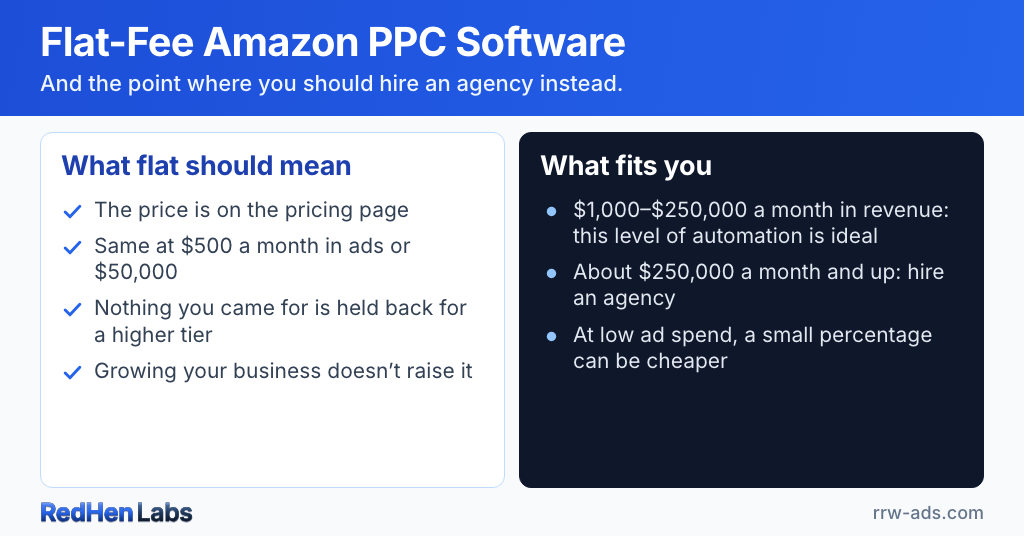
- The price is on the pricing page, where you can read it without booking a call.
- It is the same whether you spend $500 a month on ads or $50,000.
- Nothing you came for is held back for a higher tier.
- Growing your business does not raise it.
We charge $129 a month for the full platform. We could charge more, and it isn’t modesty that stops us — it’s that this is a focused product, not a bloated one, so it costs less to build and less to run. And by the time a seller has paid referral fees, fulfillment, storage, returns, and advertising, plenty of hands have already been in the till. I didn’t want to be one more.
When you should hire an agency instead — genuinely
There is a point where the honest answer is “don’t buy our software, hire someone.” Roughly $250,000 a month in revenue and up, in my view.
At that size you need advertising that goes well past Sponsored Products and Sponsored Brands — DSP, Amazon Marketing Cloud, the genuinely advanced strategies — and we don’t do those. More to the point, at that size your attention belongs on the parts of the business only you can do. Paying an agency to run the ad account is a reasonable trade when the alternative is you doing it at the cost of everything else. That is what an agency is for, and it’s worth saying plainly rather than pretending software is always the answer. (If you’re weighing one now, here’s what agencies really cost.)
And who this is for
Between roughly $1,000 and $250,000 a month in revenue, this level of automation is ideal — and it’s the range where the percentage model does the most quiet damage, because you’re growing fast enough to keep raising your own bill.
In that band you have enough data for rules and AI to work with, enough spend that manual management eats your evenings, and not enough scale to justify handing over a percentage of the business. You need the ad work done consistently, you need to see real profit per product after COGS and fees rather than ACoS in isolation, and you need the bill to sit still while you grow. That’s the whole thesis.
I built it because nobody was selling it to me at a price that made sense. I still run my own Amazon advertising on it every day.
Frequently asked questions
What should Amazon PPC software cost?
There is no single right number, but there is a right shape: a price you can read on a page and that does not change when your ad spend does. Flat monthly fees for seller-grade tools generally run somewhere between $20 and $200 a month. Be more careful about the model than the number — a low monthly fee attached to a percentage of ad spend can end up costing far more than a higher flat fee once you scale.
Is a flat fee always cheaper than a percentage of ad spend?
No, and anyone who says so is selling. At low ad spend a small percentage is often cheaper than a flat fee. What a percentage does is grow: it rises every time you add budget to a campaign that is already working, so the crossover arrives exactly when things are going well. A flat fee costs more at the bottom and less forever after that.
When should I hire an Amazon PPC agency instead of buying software?
When you are genuinely large enough to need advertising beyond Sponsored Products and Sponsored Brands — DSP, Amazon Marketing Cloud, and the strategies that come with them — and when your time is better spent on the rest of the business. Somewhere north of roughly $250,000 a month in revenue, an agency starts to make real sense. Below that, an agency is usually charging you a percentage to do work that software plus an hour a week can do.
Why do so many Amazon PPC tools charge a percentage of ad spend?
Because it scales their revenue without scaling their work. Managing a $50,000 account is not ten times the work of managing a $5,000 one, but a percentage bills as though it were. It also transfers none of the risk: the fee is charged on spend rather than on results, so it costs the same whether the campaign made money or lost it.
Related reading